Blog

  • Trademark Registration Services in Lahore: Complete Guide to Trademark Services, Protection and Renewal

    Your business name, logo, and brand identity are valuable assets that deserve legal protection. Whether you operate a clothing brand, restaurant, manufacturing company, online store, or startup, protecting your trademark can help safeguard your business identity against unauthorized use.

    Our Trademark Registration Services in Lahore are designed to assist business owners with trademark searches, applications, examination objections, opposition proceedings, and renewals under Pakistani law. We help businesses understand the registration process, identify potential legal issues, and take appropriate steps to protect their brands.

    From newly established businesses to growing companies, obtaining professional trademark guidance can be an important part of building a secure and recognizable business identity.

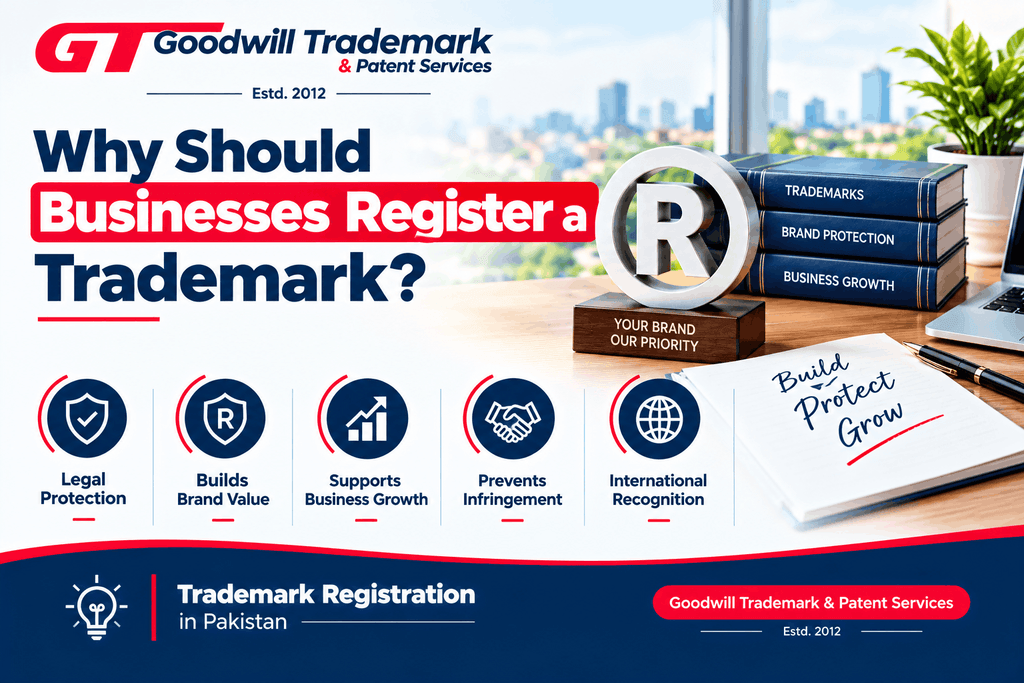
    Why Is Trademark Registration Important for Businesses in Lahore?

    A trademark distinguishes your products or services from those offered by other businesses. It can include a distinctive brand name, logo, symbol, or combination of elements.

    Businesses operating in Lahore’s commercial areas, including Gulberg, DHA, Johar Town, Liberty Market, and other business districts, often invest significantly in developing their brand identity.

    Trademark registration in Lahore can provide important legal and commercial advantages, including:

    • Brand protection: Helps protect distinctive names and logos under Pakistan’s trademark laws.
    • Exclusive statutory rights: Provides registered proprietors with rights concerning covered goods or services.
    • Protection against infringement: Supports legal action where another party’s use constitutes trademark infringement.
    • Business recognition: Helps customers distinguish your products or services from competitors.
    • Commercial value: A registered trademark can be licensed or assigned, subject to applicable legal requirements.
    • Long-term protection: Registration can be renewed for successive periods of ten years.

    Although registration is not compulsory for every business, registered trademarks generally provide clearer statutory protection than reliance on unregistered rights alone.

    Our Trademark Services in Lahore
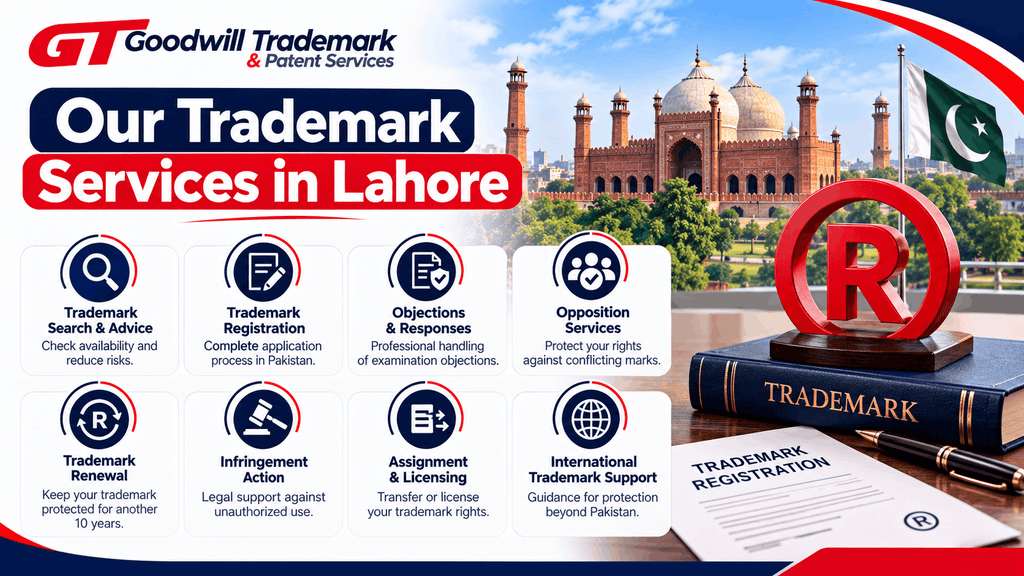
    Businesses require different types of trademark assistance depending on their stage of development and the legal issues involved.

    Our trademark-related services cover the following areas.

    1. Trademark Search and Brand Availability

    Before applying for trademark registration, it is important to determine whether a proposed brand name or logo may conflict with an existing trademark.

    A trademark search helps identify earlier marks that could create registration difficulties.

    The review may include identical names, similar spelling, pronunciation, visual appearance, and relevant goods or services.

    2. Trademark Registration in Lahore

    Our trademark registration assistance covers the preparation and filing of applications under the Trade Marks Ordinance, 2001, and Trade Marks Rules, 2004.

    The process includes assessing the proposed mark, selecting appropriate classes, preparing application particulars, and addressing relevant Registry requirements.

    3. Trademark Objection Reply

    The Trade Marks Registry may object to an application on grounds such as lack of distinctiveness, descriptive wording, or conflicts with earlier trademarks.

    We assist with reviewing examination objections and preparing responses based on the relevant statutory provisions and available evidence.

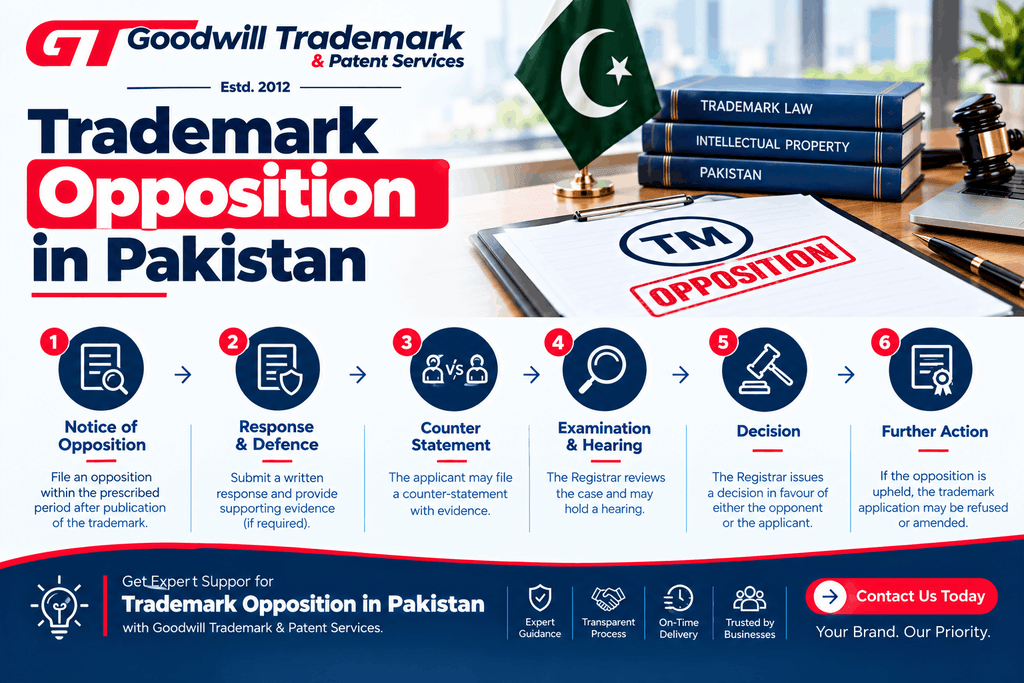
    4. Trademark Opposition Proceedings

    An opposition arises when a third party challenges an advertised trademark application.

    Legal assistance may involve preparing a notice of opposition, counter-statement, evidence, and written submissions.

    The appropriate response depends on the grounds of opposition and the facts of the case.

    5. Trademark Renewal in Lahore

    Registered trademarks generally require renewal every ten years.

    Our trademark renewal in Lahore assistance focuses on checking registration details, identifying renewal deadlines, preparing the prescribed renewal application, and addressing applicable filing requirements.

    6. Trademark Infringement and Brand Protection

    Unauthorized use of a registered trademark may give rise to infringement proceedings where the statutory requirements are satisfied.

    Trademark protection services may include assessing the alleged infringement, reviewing evidence, preparing legal notices, and advising on available remedies.

    Trademark Registration Process in Lahore
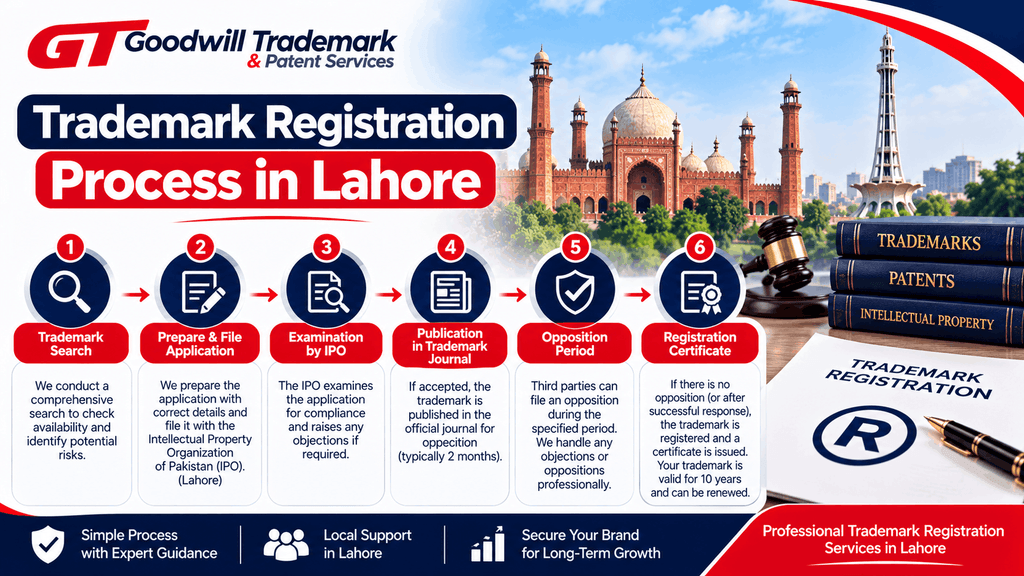
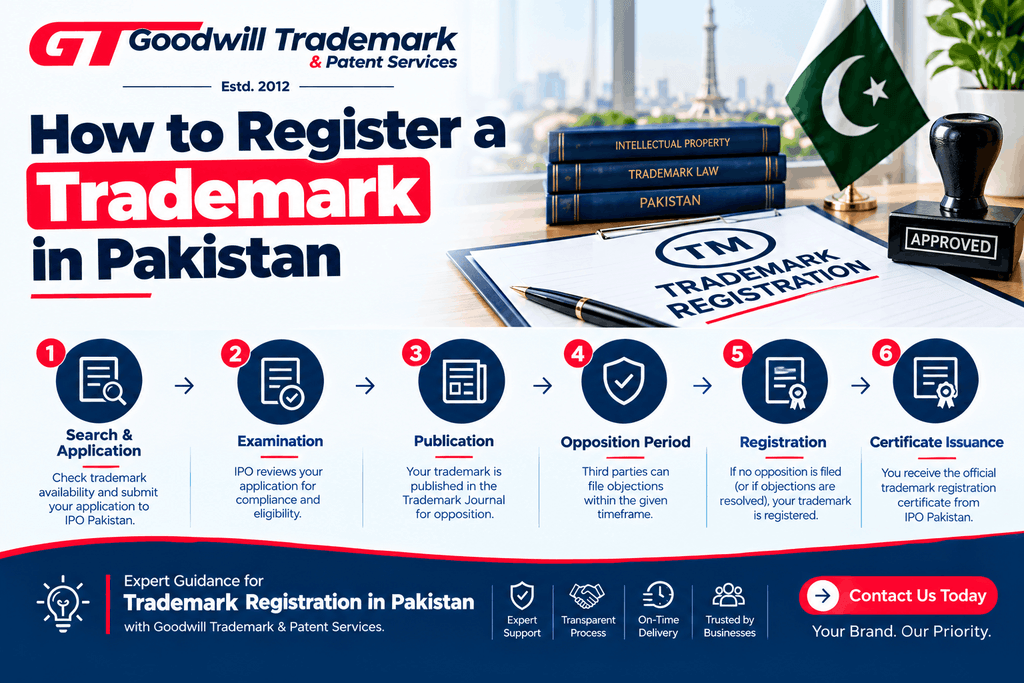
    Trademark registration in Pakistan is administered through the Trade Marks Registry under the Intellectual Property Organization of Pakistan (IPO-Pakistan).

    The main steps include:

    Step 1: Trademark Search

    Review earlier registered and pending marks to assess potential conflicts.

    Step 2: Trademark Classification

    Identify the appropriate class or classes for the applicant’s goods or services under the applicable classification system.

    Step 3: Filing the Application

    Prepare and submit the prescribed trademark application, including the relevant ownership details, representation of the mark, and goods or services specification.

    Step 4: Examination

    The Registrar examines whether the trademark satisfies the applicable legal requirements.

    Step 5: Response to Objections

    If objections are raised, the applicant may need to submit legal arguments, supporting documents, or other evidence.

    Step 6: Advertisement

    Accepted applications may be advertised in the Trade Marks Journal, allowing third parties to challenge registration.

    Step 7: Registration

    After the necessary formalities are completed and any relevant opposition issues are resolved, the trademark may proceed to registration.

    Trademark Renewal in Lahore: Keep Your Brand Protected

    Trademark renewal is essential for businesses that wish to maintain their registered trademark rights.

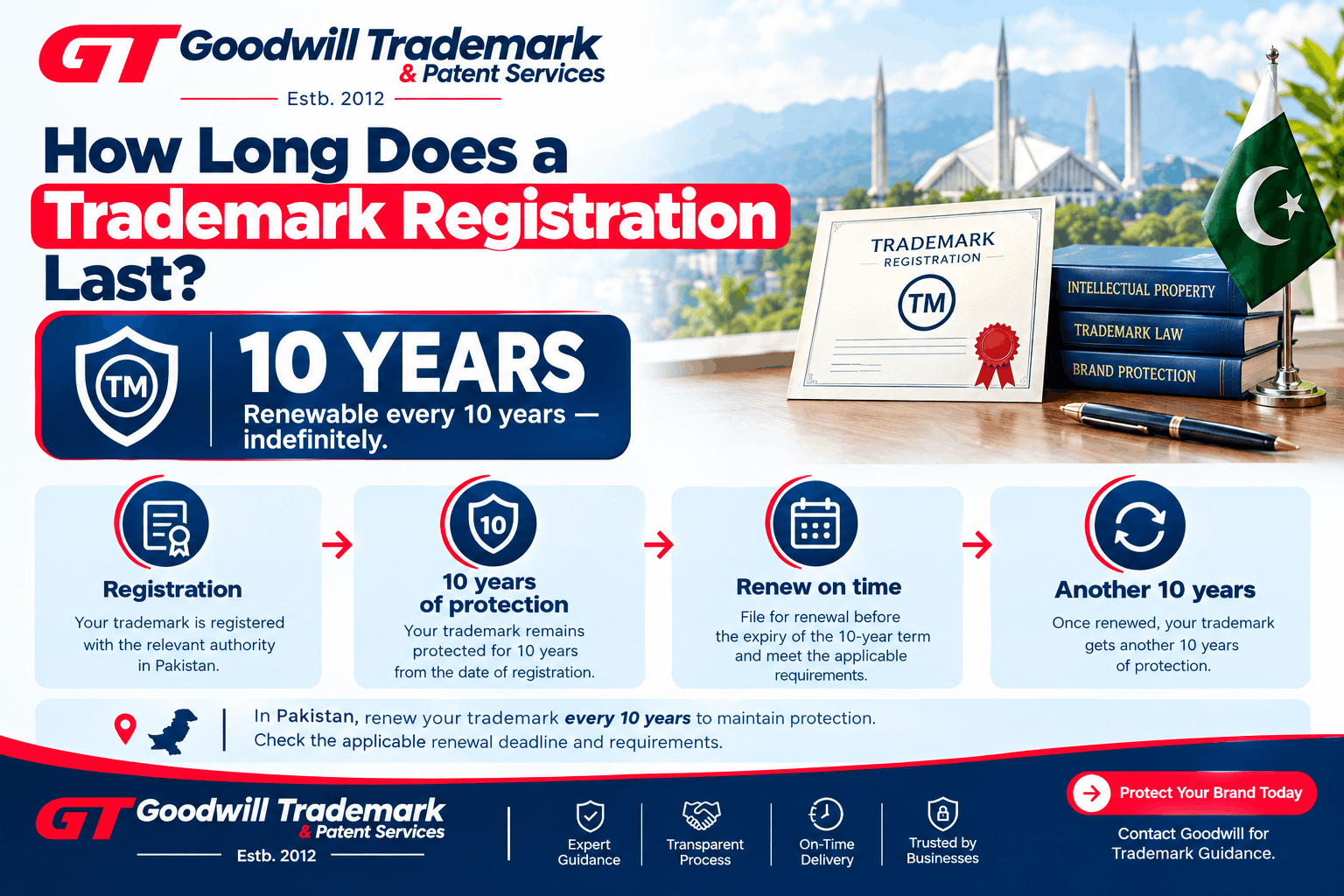
    Under Sections 34 and 35 of the Trade Marks Ordinance, 2001, trademark registration generally lasts for ten years and may be renewed for further ten-year periods.

    The Trade Marks Rules, 2004 prescribe Form TM-12 for renewal requests.

    Businesses should review their registration dates and submit renewal requests within the prescribed period.

    Where a renewal deadline has been missed, the law provides certain late renewal and restoration procedures, subject to specific conditions, additional fees, and deadlines.

    Professional assistance can help businesses understand these requirements and avoid unnecessary complications.

    Trademark Objections and Opposition in Lahore
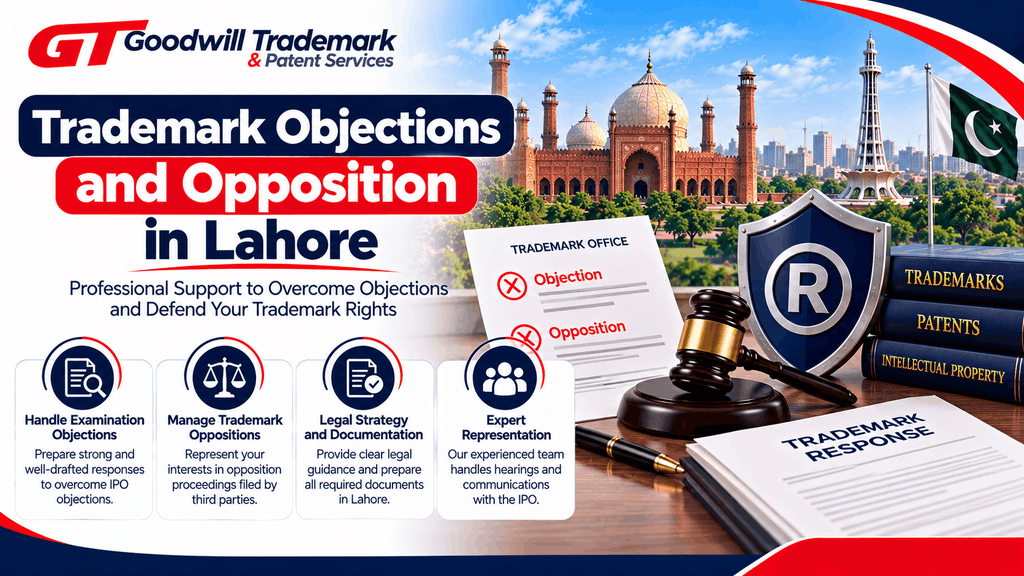
    Trademark applications may encounter legal objections before registration.

    Common examination objections arise from:

    • Lack of distinctive character.
    • Descriptive or customary wording.
    • Conflict with earlier trademarks.
    • Relevant statutory restrictions.
    • Deficiencies requiring clarification or correction.

    Sections 14 and 17 of the Trade Marks Ordinance, 2001 address important grounds for refusal.

    Opposition proceedings are different from examination objections because they involve a third party challenging an advertised trademark application.

    A carefully prepared response should address the specific legal grounds, supporting evidence, and applicable procedural requirements.

    Who Needs Trademark Registration Services in Lahore?
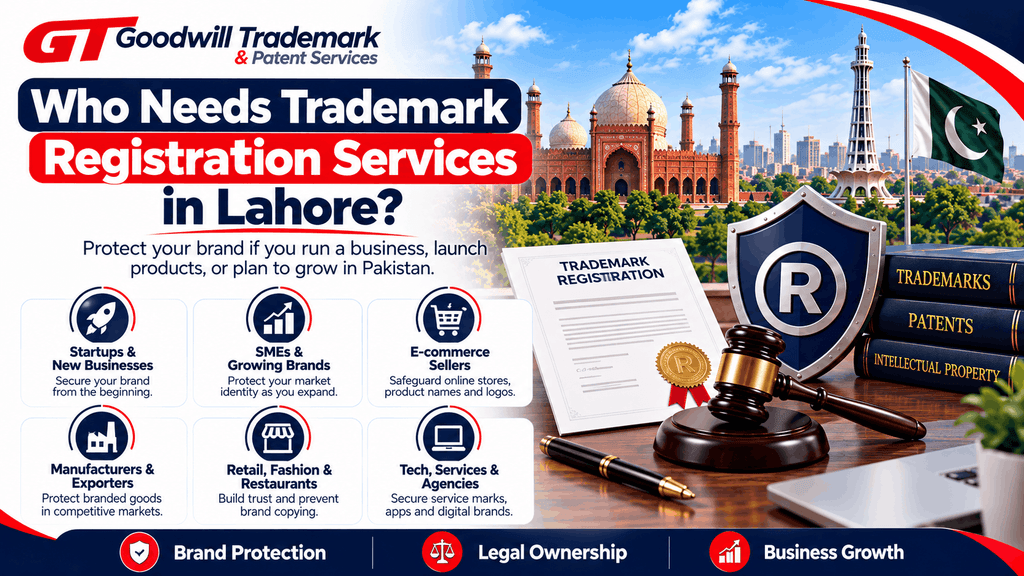
    Trademark protection is relevant to businesses in many sectors.

    Clothing and fashion businesses: Protecting distinctive labels, fashion brands, and clothing-related trademarks.

    Restaurants and food businesses: Protecting distinctive restaurant names, logos, and food-product brands.

    Manufacturers and exporters: Protecting marks used on products sold in Pakistan or international markets.

    E-commerce businesses: Protecting brand identities used on websites, marketplaces, and social media.

    IT companies and software businesses: Protecting distinctive business names, product names, and software-related marks.

    Cosmetics and beauty businesses: Protecting skincare brands, beauty-product names, and salon identities.

    Why Choose Professional Trademark Assistance?
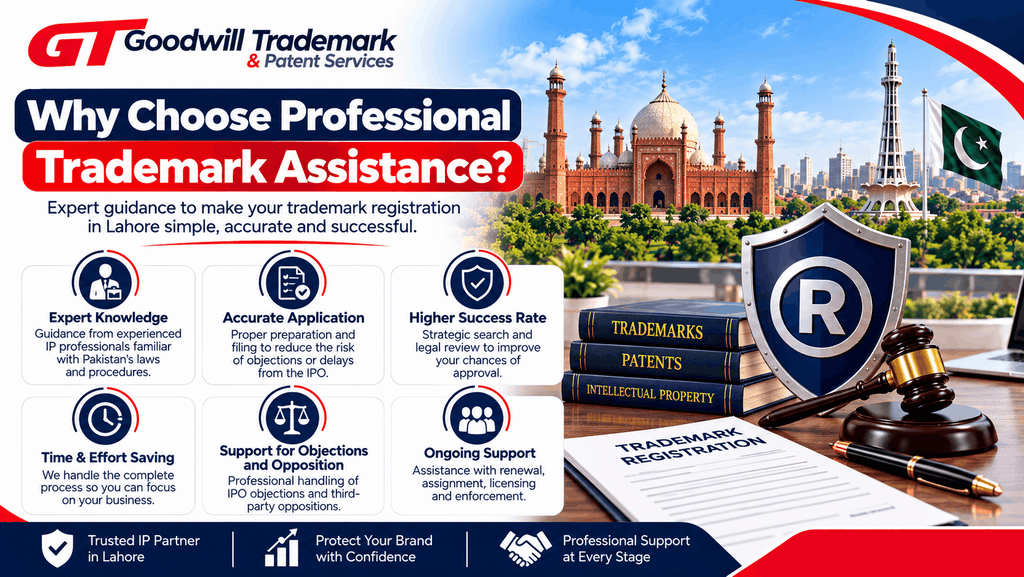
    Trademark registration involves legal requirements that go beyond submitting an application.

    A proposed trademark may be refused because of descriptive wording, lack of distinctiveness, or an earlier conflicting mark.

    Professional trademark assistance can help businesses identify these issues early, understand the applicable legislation, and prepare appropriate documentation.

    A trademark lawyer can also provide advice where a dispute involves infringement, passing off, opposition, or the validity of an existing registration.

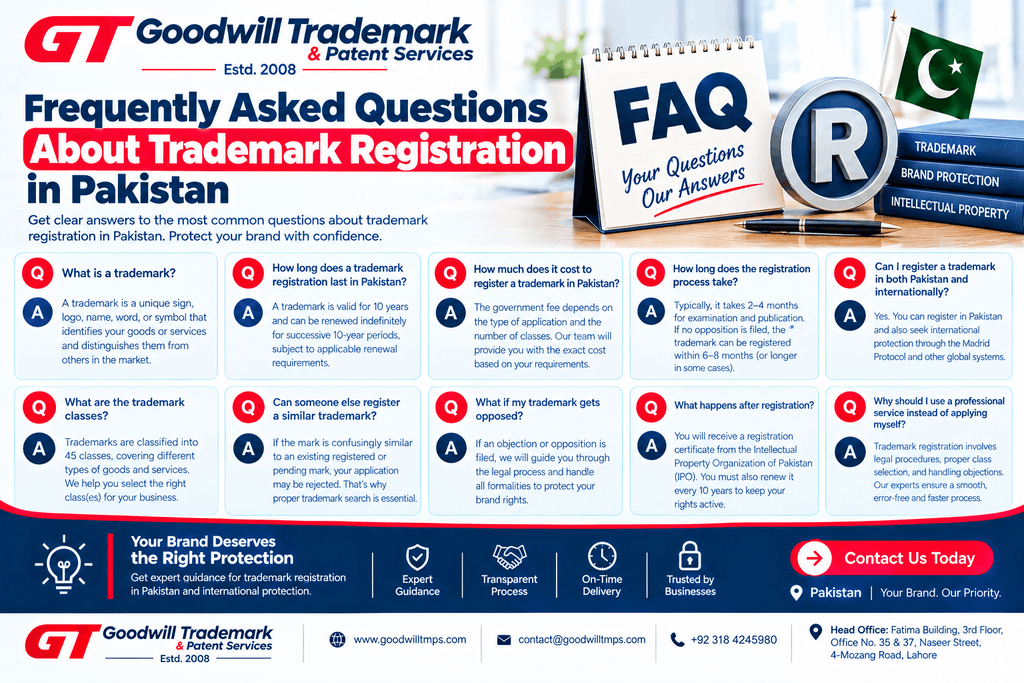
    Frequently Asked Questions
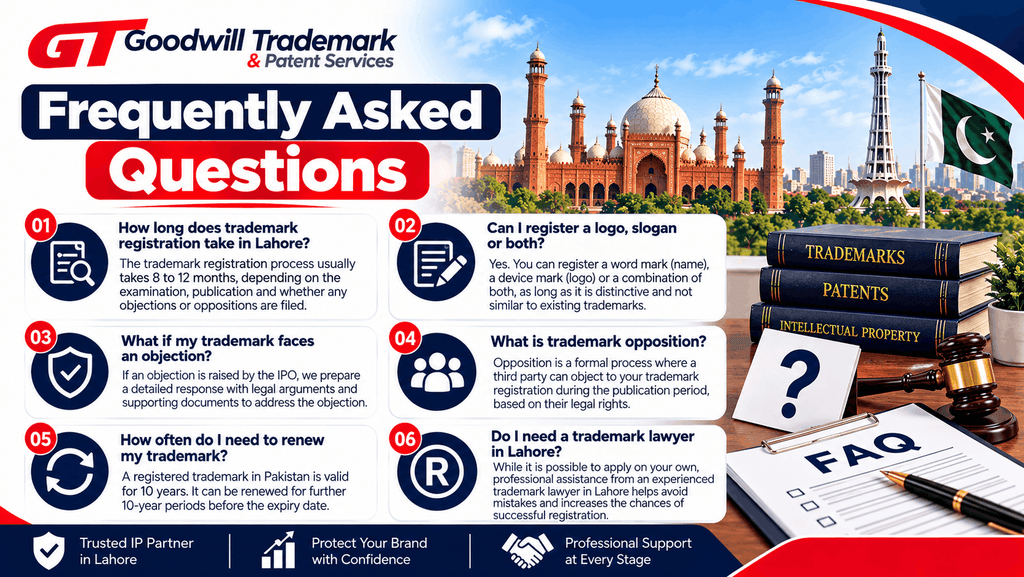
    What is the procedure for trademark registration in Lahore?

    The procedure generally involves conducting a trademark search, selecting the relevant class, filing the application, examination, advertisement, and completing registration formalities.

    How much does trademark registration cost in Lahore?

    The cost depends on current official fees, the number of classes or applications, professional charges, and whether objections or opposition proceedings arise.

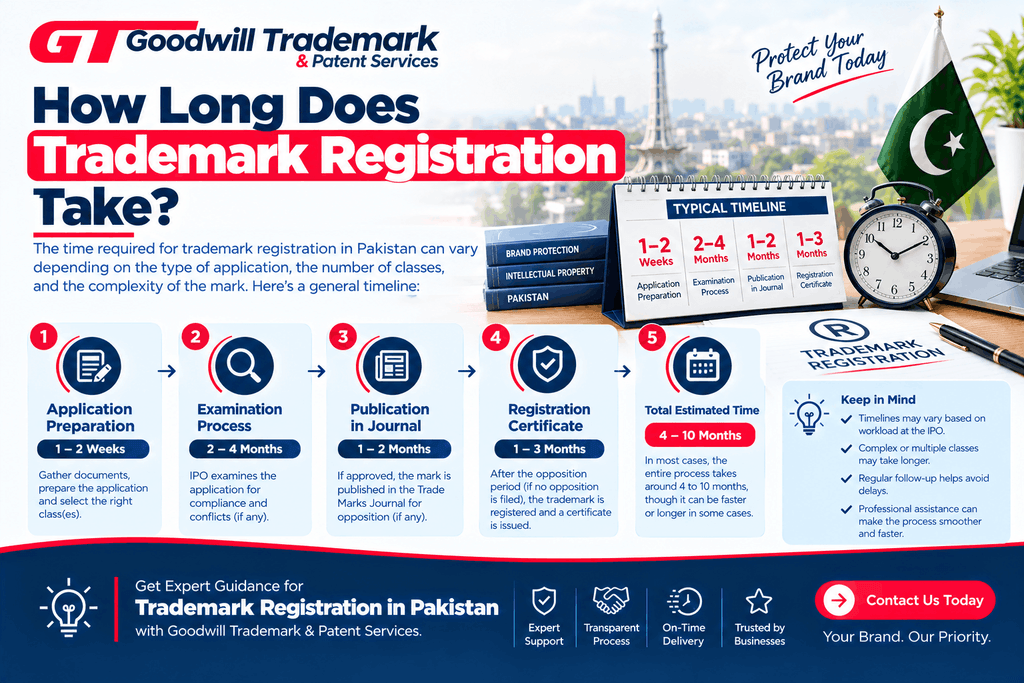
    How long does trademark registration take in Lahore?

    Processing times vary depending on the Registry’s workload, examination findings, objections, and any opposition proceedings. Registration cannot be guaranteed within a fixed period.

    Is trademark registration compulsory in Pakistan?

    Trademark registration is generally not compulsory merely to operate a business. However, registration provides important statutory rights and can make enforcement more straightforward.

    How can I renew my trademark in Lahore?

    A trademark can generally be renewed by submitting the prescribed renewal request using Form TM-12 and paying the applicable official fee within the required period.

    Can I register my business name and logo as a trademark?

    Yes, distinctive business names and logos may qualify for registration, provided they satisfy the applicable legal requirements. Separate word-mark and logo applications may be appropriate in some circumstances.

    Does trademark registration in Lahore protect my brand across Pakistan?

    Yes. Registration under Pakistan’s trademark law generally provides national protection for the mark and the goods or services covered by the registration.

    Can I register an unregistered brand that I have been using for years?

    Prior commercial use may be relevant to an application and potential legal rights. However, registration depends on applicable requirements, earlier rights, and the specific circumstances.

    Get Trademark Registration Services in Lahore

    Protecting your business identity is an important part of building a sustainable brand.

    Whether you need trademark registration in Lahore, assistance with a trademark objection, opposition proceedings, or trademark renewal in Lahore, appropriate legal guidance can help you understand your options and protect your commercial interests.

    Contact Goodwill Trademark & Patent Services to discuss your trademark registration, renewal, or brand protection requirements in Lahore.
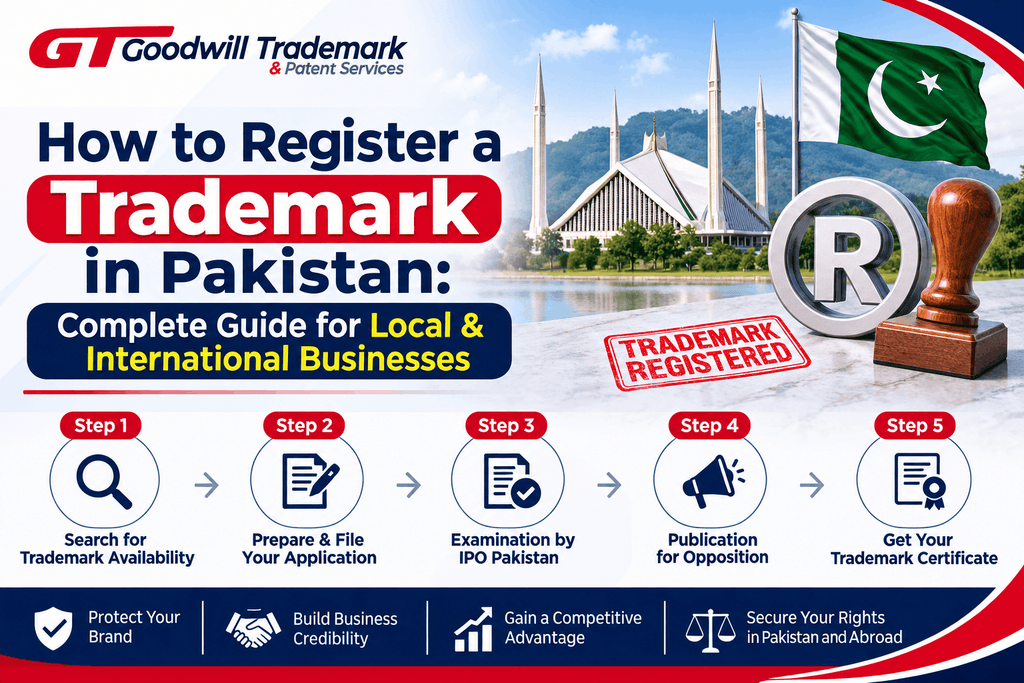

  • How to Register a Trademark in Pakistan: Complete Guide for Local & International Businesses

    Your brand name can become one of your most valuable business assets. Customers may recognise your company through its name, logo, product brand, slogan or other distinctive identity. As your business grows, protecting that identity becomes increasingly important.

    If you are starting a business, launching a new product, expanding an established brand or entering Pakistan from another country, you should consider trademark protection as part of your business strategy.

    This guide explains how to register a trademark in Pakistan, from choosing and searching your mark to filing an application, responding to objections, dealing with opposition and maintaining the registration.

    It also explains the difference between official government fees and professional fees, an important distinction that businesses should understand before budgeting for trademark registration.

    What Is a Trademark?

    A trademark is a sign that identifies and distinguishes the goods or services of one business from those of another.

    A trademark may, depending on the circumstances and applicable legal requirements, consist of a word, name, logo, device, combination of elements or another qualifying sign.

    For example, a business may use a distinctive name and logo to identify its clothing, food, technology or professional services.

    A trademark therefore does more than identify a business. It can become an important part of its reputation, goodwill and commercial identity.

    Pakistan’s principal trademark legislation is the Trade Marks Ordinance, 2001, supported by the Trade Marks Rules, 2004.

    Why Should You Register a Trademark in Pakistan?

    Trademark registration can help a business establish legal rights in its registered mark within the applicable scope of protection.

    Key benefits include:

    Brand protection — Establish a stronger legal position for your registered mark.

    Brand recognition — Protect the identity customers associate with your business.

    Business growth — Build intellectual property assets alongside your commercial operations.

    Commercial value — A trademark can become relevant to licensing, franchising, assignments and business transactions.

    Market expansion — Include trademark protection in your strategy when entering new cities, industries or countries.

    How to Register a Trademark in Pakistan

    The registration process involves several stages. You should approach each stage carefully rather than treating trademark filing as a simple form-submission exercise.

    Step 1: Choose Your Trademark

    Start by identifying the brand element you want to protect.

    This could include:

    • Brand name
    • Word mark
    • Logo
    • Device mark
    • Combined name and logo
    • Slogan or tagline
    • Other qualifying brand identifiers

    Choose a distinctive mark whenever possible.

    A highly descriptive or commonly used expression may create greater registration difficulties than a distinctive brand.

    Your trademark strategy should also consider whether you want to protect the name, logo, or both.

    Step 2: Conduct a Trademark Search

    Before filing, conduct a trademark search.

    This is one of the most important stages of the process.

    A search can help identify:

    • Identical trademarks
    • Similar trademarks
    • Earlier applications
    • Existing registrations
    • Potentially conflicting marks
    • Possible problems with your proposed brand

    Do not limit your search to an exact spelling.

    A potentially conflicting mark may look different but sound similar or create a similar commercial impression.

    A proper clearance exercise should consider the relevant mark together with the goods or services for which you intend to use it.

    A search cannot guarantee registration. The relevant authority will independently examine the application, and third parties may also have rights or grounds to challenge it.

    Step 3: Determine Your Trademark Class

    You must identify the goods or services for which you want protection.

    The Trade Marks Rules provide a classification system for goods and services.

    For example, a:

    • Clothing business
    • Restaurant
    • Software company
    • Pharmaceutical business
    • Cosmetics brand
    • Consulting firm

    may have different classification requirements.

    Do not select classes simply because another business uses them.

    Instead, consider your actual commercial activities and realistic expansion plans.

    Why does the class matter?

    Trademark protection relates to the goods or services specified in the application.

    Choosing the wrong class or an overly narrow specification can create problems later.

    If your business operates across several areas, you may need to assess whether protection should cover more than one class.

    Step 4: Identify the Applicant

    The application should identify the appropriate proprietor or applicant.

    This is particularly important for companies and international businesses.

    Before filing, consider:

    • Who owns the brand?
    • Is the owner an individual or company?
    • Is a parent company involved?
    • Is a local subsidiary involved?
    • Will a distributor use the brand?
    • Will a franchisee or licensee use it?

    International businesses should resolve ownership issues before filing rather than trying to correct ownership problems later.

    Step 5: Prepare the Trademark Application

    After completing the preliminary assessment, prepare the application using the applicable form and filing requirements.

    The Trade Marks Rules prescribe forms for applications and other trademark proceedings. The Rules state that the forms in the relevant schedules are to be used for applicable matters.

    For an ordinary application, the relevant filing information can include:

    • Applicant details
    • Address
    • Trademark representation
    • Goods or services
    • Class
    • Address for service in Pakistan
    • Other information required by the applicable form

    The Rules also contain specific requirements concerning applications and supporting material.

    Step 6: Pay the Official Trademark Filing Fee

    This is where businesses should understand an important distinction.

    Official IPO-Pakistan Fees

    The Intellectual Property Organization of Pakistan (IPO-Pakistan) publishes information concerning trademark fees and forms.

    You can check the official IPO-Pakistan Trademark Fee & Forms page here:

    IPO-Pakistan — Trademarks Fee & Forms

    The official fee schedule should be checked at the time of filing because government fees and administrative requirements can change.

    The Trade Marks Rules state that fees payable under the Ordinance and Rules are specified in the First Schedule.

    Important: Official Fees Are Not Professional Fees

    The IPO-Pakistan official fee is not the same as a trademark professional’s fee.

    The official fee is the amount payable to the relevant government authority for the applicable filing, registration or other official proceeding.

    A professional fee covers services provided by a trademark lawyer, attorney, agent or professional service provider.

    Depending on the matter, professional services may include:

    • Trademark search
    • Legal assessment
    • Class selection
    • Application preparation
    • Filing assistance
    • Application monitoring
    • Examination response
    • Objection handling
    • Opposition proceedings
    • Documentation
    • Renewal assistance
    • Trademark portfolio management

    Therefore, when comparing trademark registration costs, businesses should ask for a clear breakdown of:

    1. Official government fees

    and

    2. Professional/service fees

    These are separate cost components.

    Do not rely on old fee figures

    Online articles may contain historical fee amounts that no longer reflect the current official schedule.

    For this reason, your article should direct readers to the official IPO-Pakistan fee and forms page for the current government charges rather than presenting an old fee table as permanently applicable.

    Step 7: File the Trademark Application

    Once the application, classification and required information are ready, submit the application through the applicable filing process.

    The Trade Marks Rules provide that applications for registration are made to the Registrar and specify the applicable form and filing requirements.

    At this stage, accuracy matters.

    An incorrect:

    • Applicant name
    • Address
    • Trademark representation
    • Class
    • Goods/services description
    • Ownership detail

    can create unnecessary complications.

    Step 8: Trademark Examination

    After filing, the application goes through examination.

    The examiner may consider whether the application satisfies the relevant legal requirements and whether issues exist that affect registration.

    If the authority raises an objection, you should first understand the exact reason.

    Do not assume that every objection requires the same response.

    Depending on the circumstances, the response may involve:

    • Legal arguments
    • Evidence
    • Clarification
    • Amendments
    • Supporting documents
    • Other procedural steps

    A strong response should address the actual grounds raised against the application.

    Step 9: Publication and Trademark Opposition

    If the application progresses to the applicable publication stage, third parties may have an opportunity to oppose it under the relevant procedure.

    This creates an important distinction:

    Trademark Objection

    An objection generally arises during examination of the application.

    Trademark Opposition

    An opposition is a challenge brought by another party through the applicable opposition procedure.

    The two proceedings are not interchangeable.

    If another party opposes your trademark, you should assess the opposition carefully and respond within the applicable procedural requirements.

    Step 10: Trademark Registration

    If the application successfully completes the relevant stages and no unresolved issue prevents registration, the trademark proceeds to registration.

    The registration establishes rights according to the applicable law, registration details, goods/services and limitations.

    Registration is not the end of trademark management.

    You should continue to maintain and monitor your trademark rights.

    Step 11: Maintain and Renew Your Trademark

    Trademark owners should keep proper records of:

    • Registration number
    • Filing date
    • Registration date
    • Owner details
    • Address
    • Goods and services
    • Renewal deadlines
    • Assignments
    • Licences
    • Other relevant changes

    The Trade Marks Ordinance provides for renewal of registrations, and the Rules include procedures and forms relating to renewal.

    A business should therefore treat its trademark as an ongoing intellectual property asset rather than a one-time filing.

    Documents Required For Trademark Filing in Pakistan

    The exact requirements can vary according to the applicant and circumstances.

    Depending on the application, you may need information or documents such as:

    • Full name, business address and nationality of the applicant.
    • 15 (fifteen) prints of labels or trademark / domain name or logo etc.
    • Trading style, if any.
    • Class
    • Specification of goods or services.
    • Colours claimed (if any).
    • The first date of use of mark in Pakistan, if any, or statement that mark is proposed to be used. (If used in Pakistan, please provide proof there of by way of affidavit, publicity material, sale figures etc., which may be field later).
    • If the application is for a series of marks, please indicate how many marks are in the series.
    • Power of Attorney (Form TM-48) duly signed by the applicant and should be NOTARIZED.
    • Language; English.
    • If the word is in a language other than English, Urdu or regional Pakistani language, its translation and transliteration in the form of an affidavit (which may be filed later)
    • To claim a convention priority, please forward the followings: –
    • (a) Application number, filing date in the first convention country.
    • (b) Certified copy of the priority documents.
    • (c) Priority can be claimed within six months from the date of first convention application.
    • (d) Priority documents can be filed within three months from the filing of convention priority application in Pakistan.

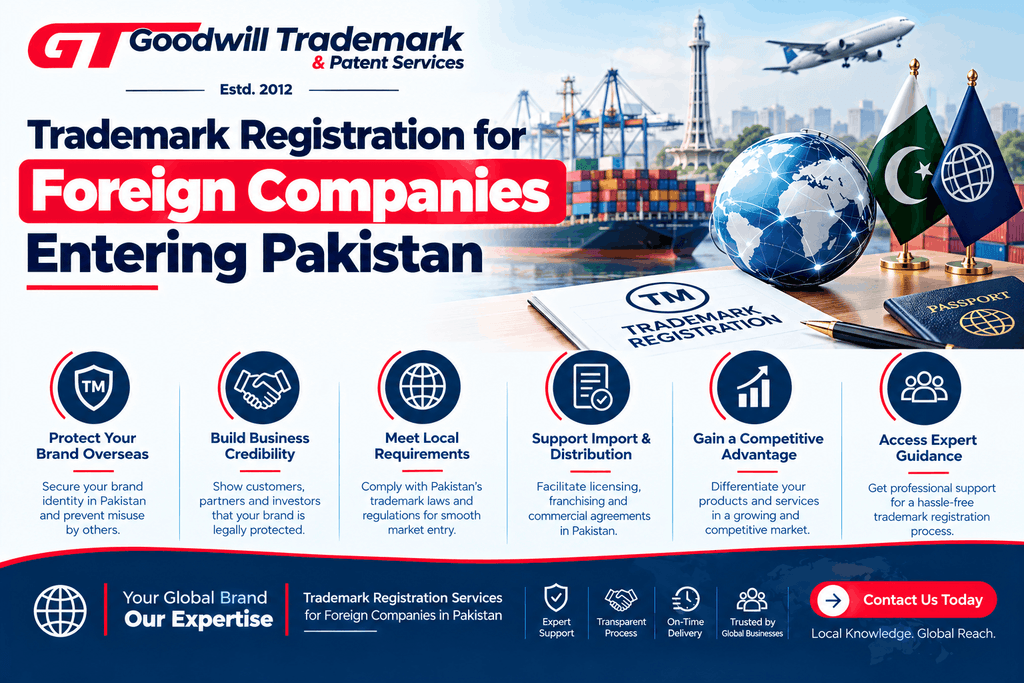
    Trademark Registration for Foreign Companies in Pakistan

    International businesses should approach Pakistan trademark protection as part of their global brand strategy.

    A trademark registered in another country does not automatically mean that the business has equivalent trademark protection in Pakistan.

    Before entering Pakistan, an international company should consider:

    1. Search the Pakistani trademark landscape

    Determine whether the proposed brand faces potentially conflicting marks.

    2. Review ownership

    Confirm which legal entity should own the Pakistani trademark.

    3. Select appropriate classes

    Match the Pakistani filing to the company’s actual commercial activities.

    4. Coordinate with the international portfolio

    Make the Pakistani filing consistent with the company’s global trademark strategy.

    5. Review local commercial arrangements

    Consider distributors, franchisees, licensees, manufacturers and other local partners.

    6. Plan enforcement

    Develop a strategy for dealing with potentially conflicting applications or unauthorised use.

    This approach helps international businesses reduce avoidable problems when entering the Pakistani market.

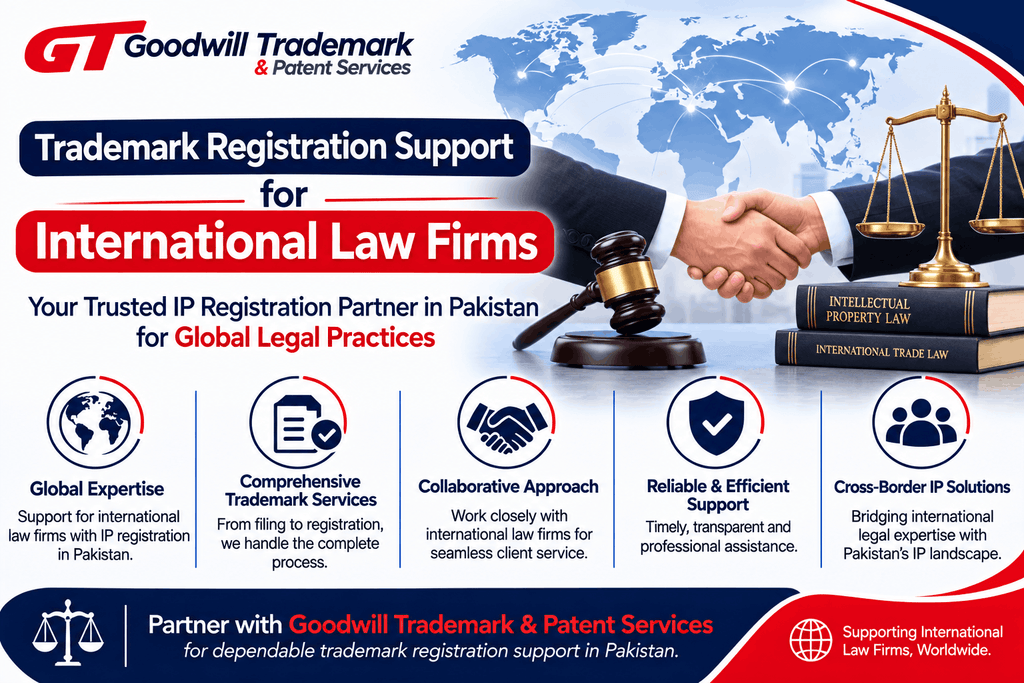
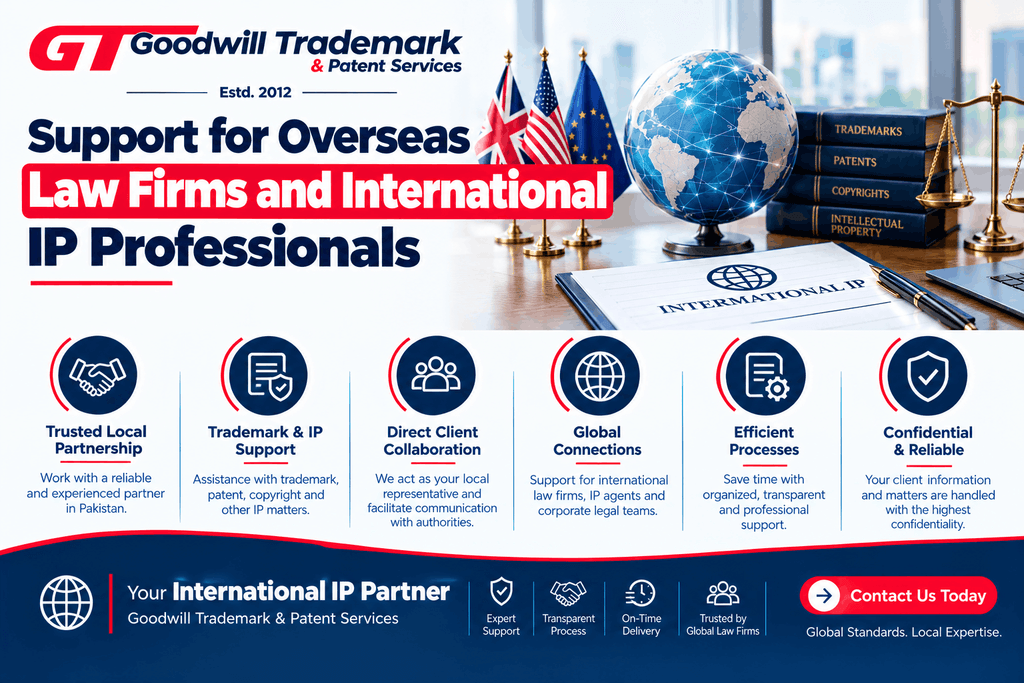
    Trademark Registration Support for International Law Firms

    International law firms and IP professionals may need local assistance when their clients require trademark protection in Pakistan.

    Goodwill Trademark & Patent Services can support Pakistan-related trademark matters such as:

    • Local trademark searches
    • Filing assistance
    • Application monitoring
    • Examination matters
    • Objection responses
    • Opposition matters
    • Renewals
    • Assignments
    • Licensing support
    • Trademark portfolio management

    For international counsel, effective local coordination can make cross-border trademark management more efficient.

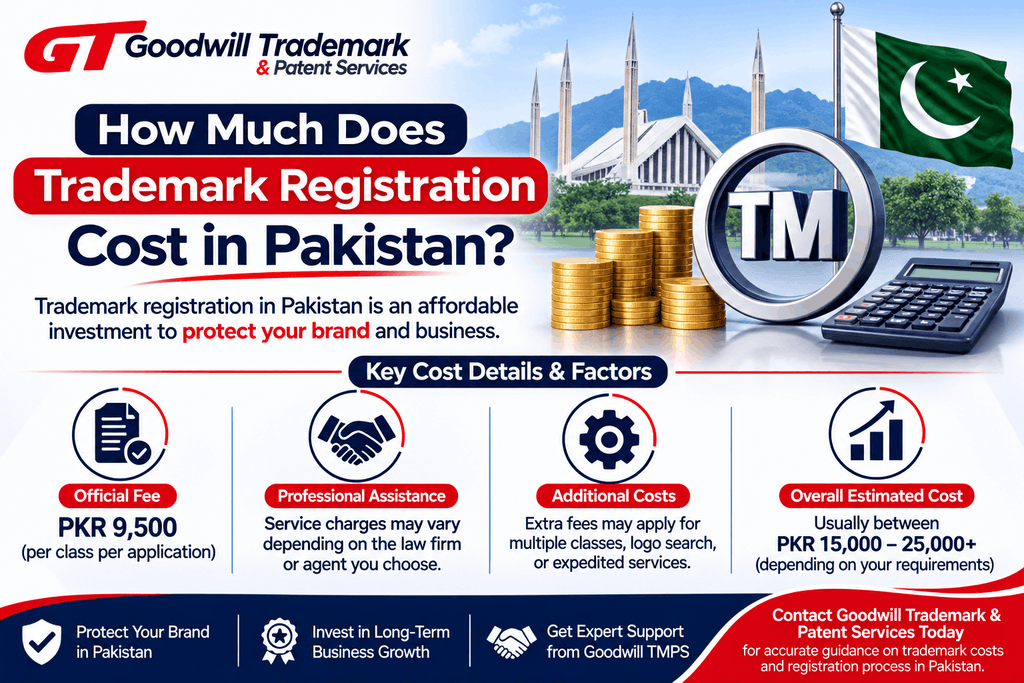
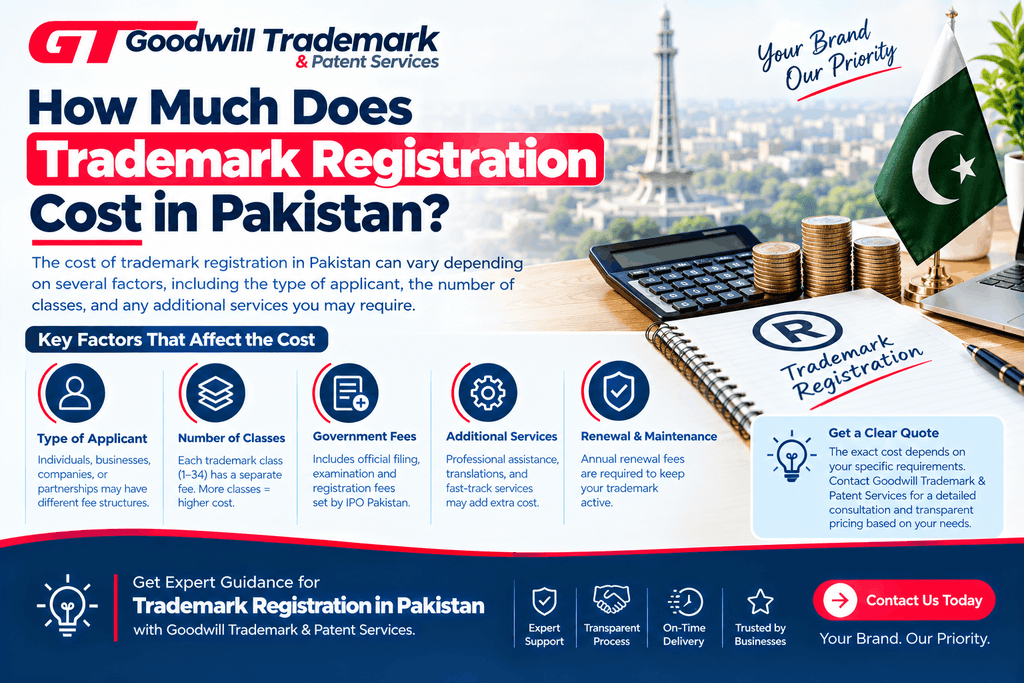
    How Much Does Trademark Registration Cost in Pakistan?

    There is no single universal price for every trademark matter.

    Your total cost can depend on:

    • Number of trademark applications
    • Number of classes
    • Official government fees
    • Professional fees
    • Search requirements
    • Objection proceedings
    • Opposition proceedings
    • Documentation
    • Additional procedural requirements

    Official fee vs professional fee

    This distinction is particularly important:

    Official fee: Paid to the relevant government authority according to the applicable official fee schedule.

    Professional fee: Charged by a lawyer, trademark attorney, agent or professional service provider for the work they perform.

    The IPO-Pakistan Trademark Fee & Forms page lists official fees and forms; it should not be treated as a schedule of professional fees charged by private practitioners. Check the official page for the current government charges.

    For professional services, businesses should obtain a separate quotation that clearly explains what the service includes.

    Why Choose Goodwill Trademark & Patent Services?

    Goodwill Trademark & Patent Services (GT&PS) provides trademark and intellectual property services for local and international clients requiring trademark assistance in Pakistan.

    Our trademark services include:

    • Trademark Registration
    • Trademark Search
    • Trademark Objection Assistance
    • Trademark Opposition
    • Trademark Renewal
    • Trademark Portfolio Management
    • Trademark Assignment and Licensing Support
    • Trademark Dispute and Litigation Support
    • Brand Name Protection
    • Logo Registration and Protection
    • Support for International Clients

    We have been providing our services since 2012 and work with clients in Pakistan as well as international clients who require support with Pakistan-related intellectual property matters.

    Our approach focuses on understanding the client’s commercial objective, preparing matters carefully and providing professional support throughout the relevant process.

  • Trademark Registration in Pakistan: A Complete Guide for Local & International Businesses

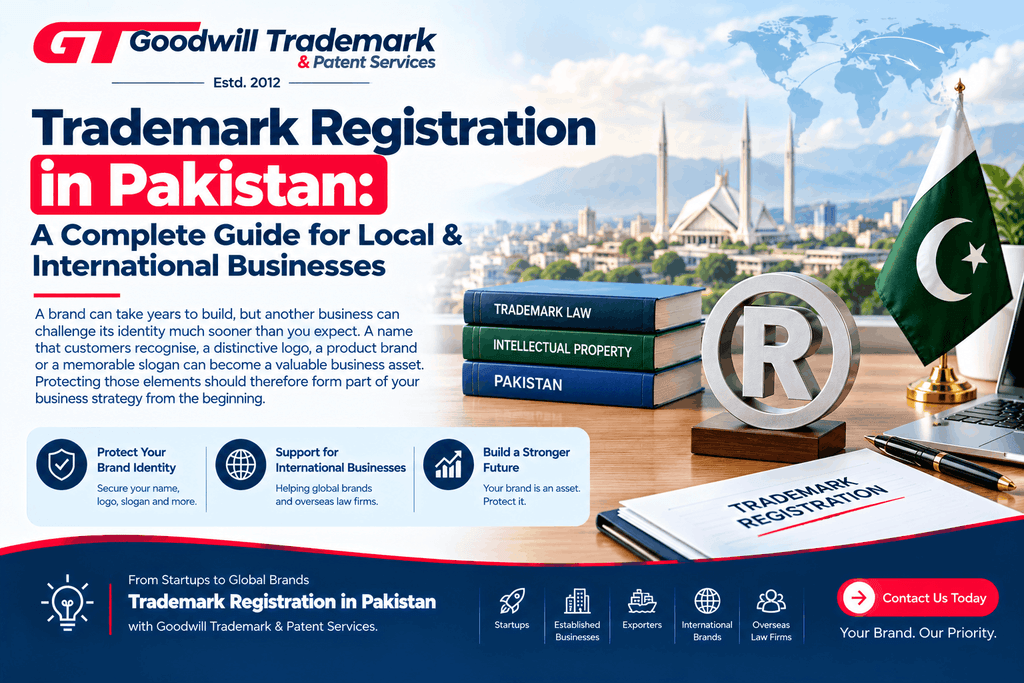
    A brand can take years to build, but another business can challenge its identity much sooner than you expect. A name that customers recognize, a distinctive logo, a product brand or a memorable slogan can become a valuable business asset. Protecting those elements should therefore form part of your business strategy from the beginning.

    Trademark registration in Pakistan gives businesses a formal legal route to protect qualifying brand identifiers. It also plays an important role for foreign companies, international brands and overseas law firms dealing with trademark matters connected to the Pakistani market.

    Whether you are launching a Pakistani startup, expanding an established company, exporting products or bringing an international brand into Pakistan, you should assess trademark protection before investing heavily in your brand.

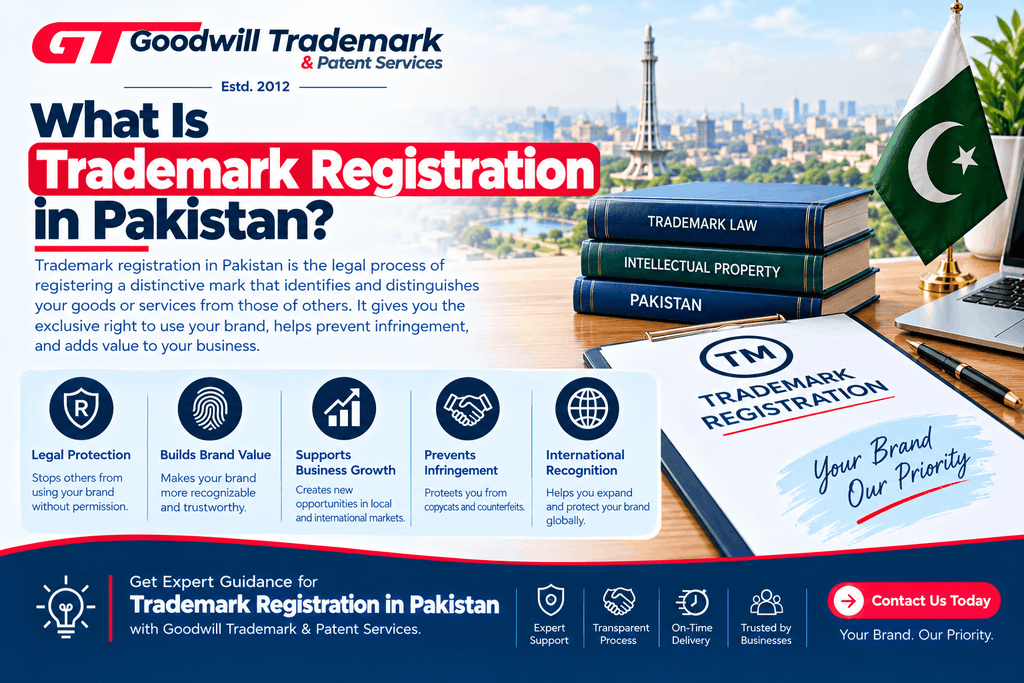
    What Is Trademark Registration in Pakistan?

    Trademark registration is the process through which an eligible trademark is applied for and, if the application successfully completes the applicable procedure, registered with the relevant trademark authority in Pakistan.

    Pakistan’s principal trademark legislation is the Trade Marks Ordinance, 2001, while the Trade Marks Rules, 2004 provide procedural rules and requirements.

    A trademark can identify and distinguish the goods or services of one business from those of another. Depending on the circumstances and legal requirements, businesses may seek protection for brand names, words, logos, devices and other qualifying marks.

    Registration should not be viewed simply as paperwork. It forms part of a wider strategy for building, protecting and managing a commercial brand.

    Why Should Businesses Register a Trademark?

    Businesses often spend substantial amounts on advertising, packaging, websites, social media and customer development. If another party adopts a confusingly similar brand, the business may face commercial and legal complications.

    Trademark registration can help a business establish rights in its registered mark within the relevant scope of protection.

    Build a recognizable brand

    A distinctive trademark helps customers identify your goods or services and distinguish them from competitors.

    Strengthen brand protection

    Registration can provide a stronger legal position when dealing with conflicting marks or unauthorised use, subject to the applicable law and circumstances.

    Protect business investment

    Your brand may become increasingly valuable as your business grows. Protecting it early can form part of responsible intellectual property management.

    Support expansion

    A business that plans to enter new cities, industries or countries should consider trademark protection as part of its expansion strategy.

    Create a commercial asset

    Trademark rights can become relevant to licensing, franchising, assignments, acquisitions and other commercial transactions.

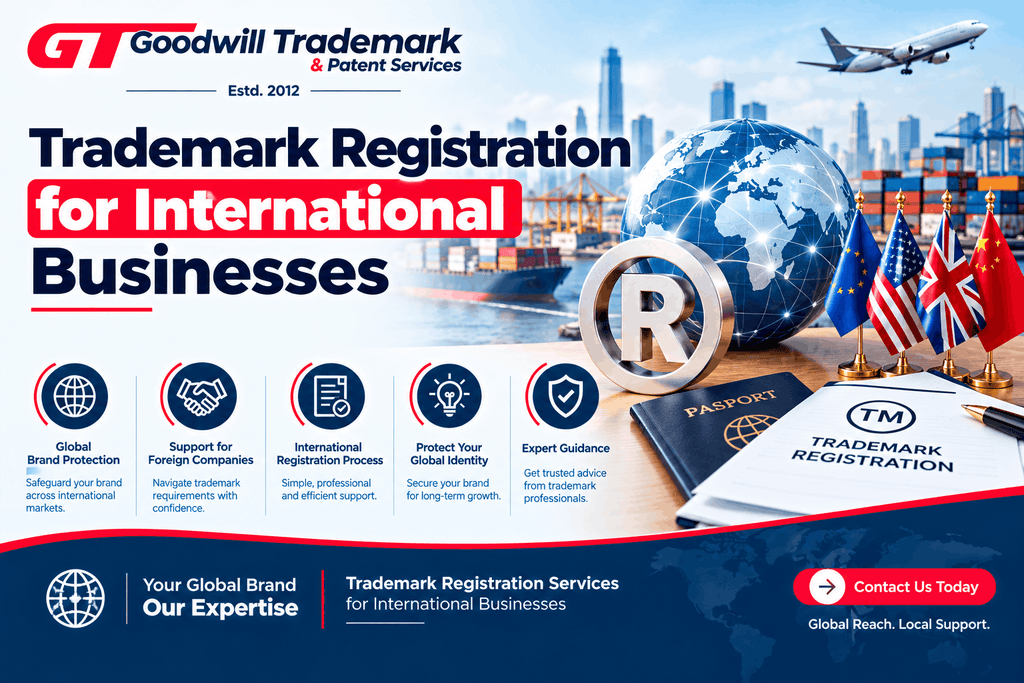
    Trademark Registration for International Businesses

    Foreign companies should not assume that registration in their home country automatically gives them the same trademark protection in Pakistan.

    Trademark rights generally operate on a territorial basis. A business should therefore assess protection in every market that matters to its commercial plans.

    For an international brand entering Pakistan, trademark planning should ideally begin before the commercial launch.

    What Should You Protect?

    Many businesses initially think only about their logo. That can be too narrow.

    Depending on your circumstances and the applicable requirements, you may need to assess different brand elements separately.

    Brand name

    Your business may use a particular word or name to identify its products or services. If that name functions as a trademark and meets the relevant requirements, you may consider filing it for protection.

    Logo

    A distinctive visual design can form an important part of a brand’s identity.

    Word and logo combination

    Some businesses use their name together with a graphic design. You should consider carefully what elements your filing strategy should cover.

    Slogan or tagline

    A distinctive slogan may have trademark potential, but not every advertising phrase qualifies for registration.

    Product or packaging elements

    Certain non-traditional marks may receive protection in appropriate circumstances, subject to the legal requirements.

    The correct filing strategy depends on the mark, the business, the goods or services and the protection you want to achieve.

    How to Register a Trademark in Pakistan

    The exact procedure can vary according to the circumstances of the application, but businesses can generally approach the process as a series of stages.

    1. Identify the trademark

    Decide which brand name, logo or other qualifying mark you want to protect.

    2. Assess distinctiveness

    Review whether the proposed mark has the characteristics required for registration and whether it creates potential legal concerns.

    3. Conduct a trademark search

    Search for identical and potentially conflicting marks before investing heavily in the brand.

    4. Determine the relevant goods and services

    Identify the appropriate classification and specification for your business activities.

    5. Prepare the application

    Prepare the applicant information, representation of the mark, goods or services and other required information and documentation.

    6. File the application

    Submit the application through the applicable trademark filing procedure.

    7. Respond to examination issues

    The trademark authority may raise an objection or other issue during examination. If this happens, the applicant must assess the grounds and respond according to the applicable procedure.

    8. Deal with publication and opposition

    Where the application reaches the relevant publication stage, a third party may have an opportunity to oppose it under the applicable procedure.

    9. Obtain registration

    If the application successfully completes the required stages and no unresolved issue prevents registration, the mark can proceed to registration.

    10. Manage the registration

    Registration does not eliminate the need for ongoing brand management. Businesses should monitor their marks, maintain accurate ownership records and deal with renewal and other post-registration matters when required.

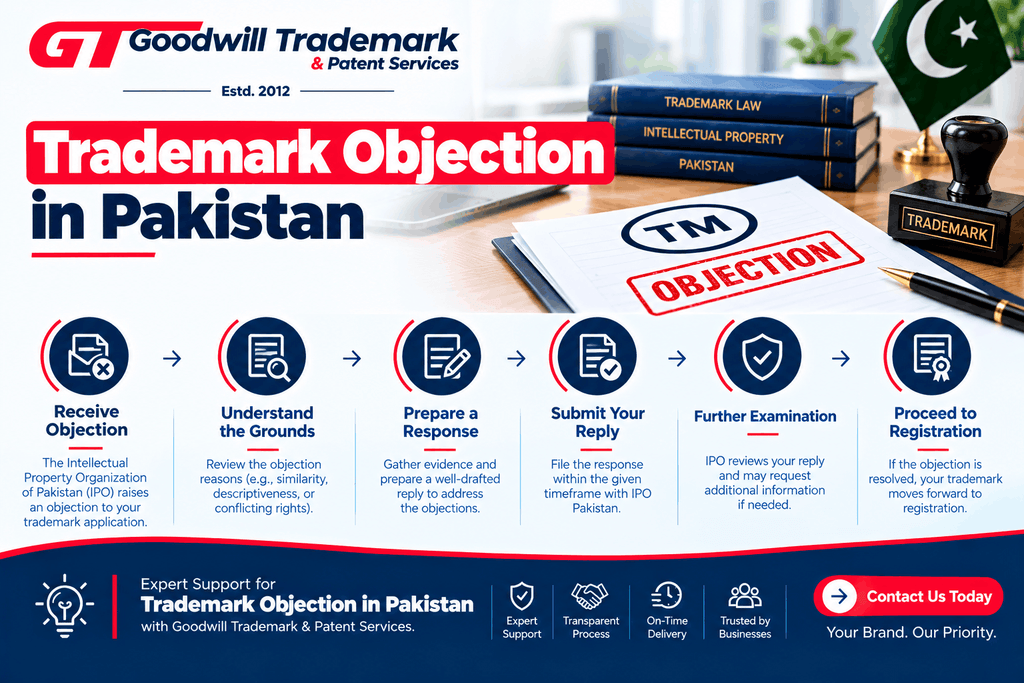
    Trademark Objection in Pakistan

    An examination objection means that the trademark application has encountered an issue that requires attention during the examination process.

    The applicant should first understand why the authority raised the objection.

    Depending on the issue, the response may involve:

    • Legal arguments
    • Clarification
    • Amendments
    • Evidence
    • Supporting documents
    • Other procedural steps

    A generic response may not adequately address the specific grounds raised against the application.

    Trademark Opposition in Pakistan

    Trademark opposition is different from an examination objection.

    An objection arises during examination of the application, while an opposition allows an eligible third party to challenge an application through the applicable opposition procedure.

    A business may face opposition because another party believes that registration could affect its existing rights or interests.

    If your application faces opposition, you should assess:

    • Who filed the opposition
    • Their claimed rights
    • The similarity between the marks
    • The relevant goods or services
    • The evidence available
    • The applicable legal grounds
    • The procedural deadlines

    Trademark disputes require careful handling because the outcome can affect the future use and value of a brand.

    Trademark Registration for Foreign Companies Entering Pakistan

    An international company should treat Pakistan as a separate trademark jurisdiction when planning market entry.

    Before launching a brand, the company can assess:

    Brand availability

    Check whether the proposed trademark faces existing registrations or applications.

    Local filing strategy

    Determine what should be protected in Pakistan and under whose ownership.

    Commercial partners

    Review distributors, franchisees, licensees and other local partners who may interact with the brand.

    Portfolio coordination

    Ensure the Pakistani trademark strategy fits into the company’s international portfolio.

    Enforcement planning

    Consider how the business will monitor and respond to potentially conflicting use after entering the market.

    This approach can reduce avoidable trademark risks during international expansion.

    Support for Overseas Law Firms and International IP Professionals

    International law firms often need reliable local assistance when their clients require trademark services in Pakistan.

    A local trademark practice can support overseas counsel with matters such as:

    • Pakistan trademark searches
    • Local trademark filings
    • Examination matters
    • Objection responses
    • Opposition proceedings
    • Renewals
    • Assignments
    • Licensing matters
    • Trademark portfolio management
    • Local procedural coordination

    For international counsel, the quality of local coordination matters because missed deadlines, incomplete information or misunderstandings about local procedure can affect the client’s position.

    Trademark Protection Does Not End With Registration

    A successful registration should become part of an ongoing intellectual property strategy.

    Businesses should periodically review their trademark portfolio and consider:

    • Renewal requirements
    • Ownership changes
    • New products
    • New services
    • New business names
    • New logos
    • New geographic markets
    • Licensing arrangements
    • Potential infringement
    • Conflicting applications
    • Portfolio consolidation

    Companies with multiple brands can benefit from maintaining a structured trademark portfolio rather than treating every registration as an isolated matter.

    Local and International Trademark Strategy: What Changes?

    The fundamental objective remains the same: protect the brand in the markets where the business needs rights.

    However, international businesses face additional considerations.

    Local BusinessInternational Business
    Protect Pakistani brandsProtect international brands in Pakistan
    Assess local conflictsAssess Pakistani conflicts before market entry
    Plan Pakistani classesCoordinate Pakistani classes with global portfolio
    Monitor local competitorsCoordinate monitoring across jurisdictions
    Manage local renewalsManage cross-border deadlines
    Expand from PakistanEnter Pakistan as a new market

    Neither approach should rely on a one-size-fits-all filing strategy.

  • What Is LCCI? A Complete Guide to Lahore Chamber of Commerce & Industry

    1-What Is LCCI?

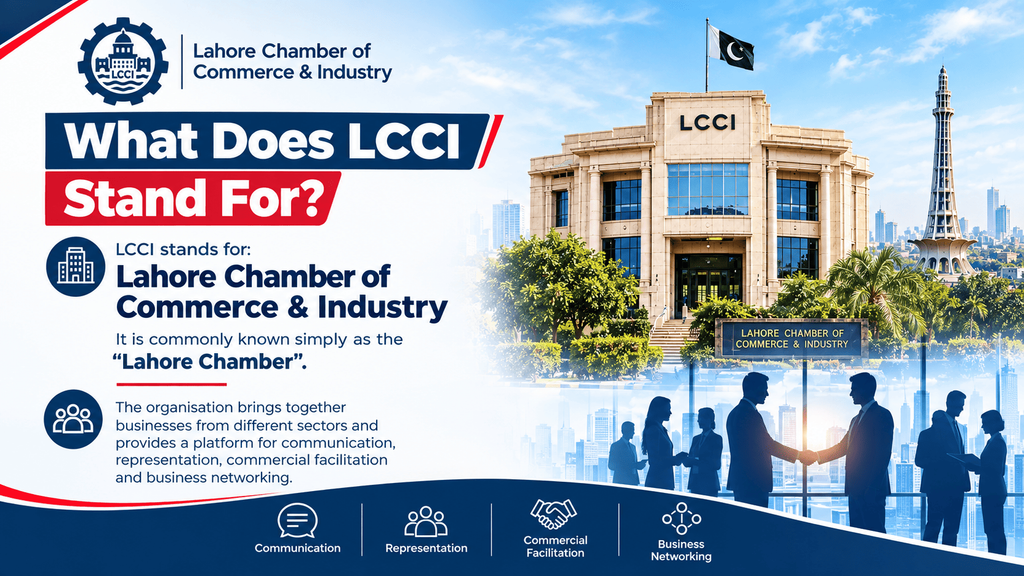
    LCCI stands for Lahore Chamber of Commerce & Industry. It is a business organization that represents the interests of businesses, traders, industrialists and other members of the business community in Lahore.
    The Chamber provides a platform where businesses can raise commercial and industry-related concerns, participate in business activities and engage with other stakeholders. It also plays an important role in policy advocacy and works on issues affecting trade and industry.

    According to LCCI’s own published material, its history goes back to 1923, when it was established as the Northern India Chamber of Commerce and Industry. The organization has since developed into a major business-support institution serving Lahore’s commercial and industrial community

    2-What Does LCCI Stand For?

    It is commonly known simply as the Lahore Chamber.

    The organization brings together businesses from different sectors and provides a platform for communication, representation, commercial facilitation and business networking.

    3-What Is the Purpose of LCCI?

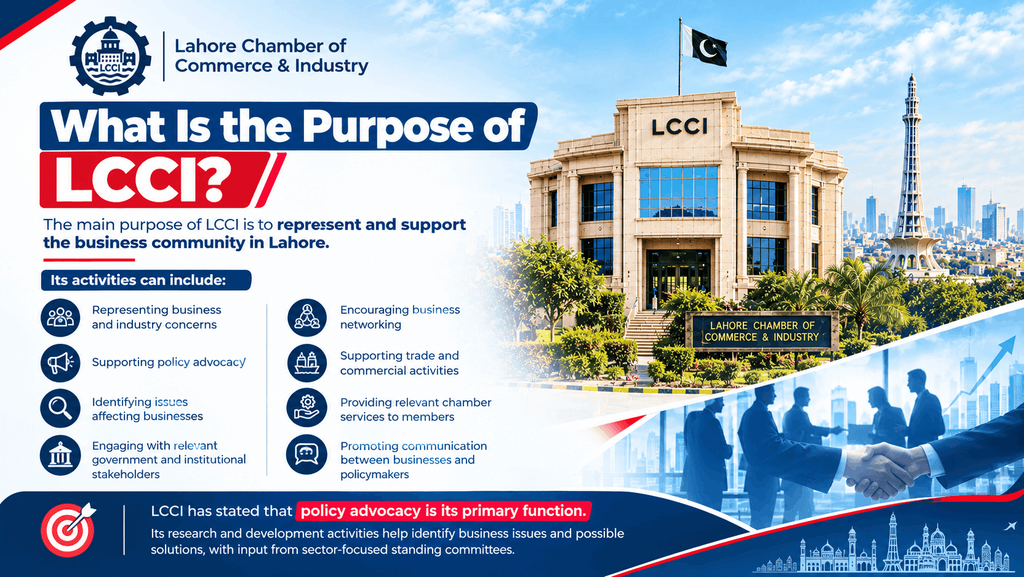
    The main purpose of LCCI is to represent and support the business community in Lahore.
    Its activities can include:

    • Representing business and industry concerns
    • Supporting policy advocacy
    • Identifying issues affecting businesses
    • Engaging with relevant government and institutional stakeholders
    • Encouraging business networking
    • Supporting trade and commercial activities
    • Providing relevant chamber services to members
    • Promoting communication between businesses and policymakers

    LCCI has stated that policy advocacy is its primary function. Its research and development activities help identify business issues and possible solutions, with input from sector-focused standing committees.


    4-How Does LCCI Work?

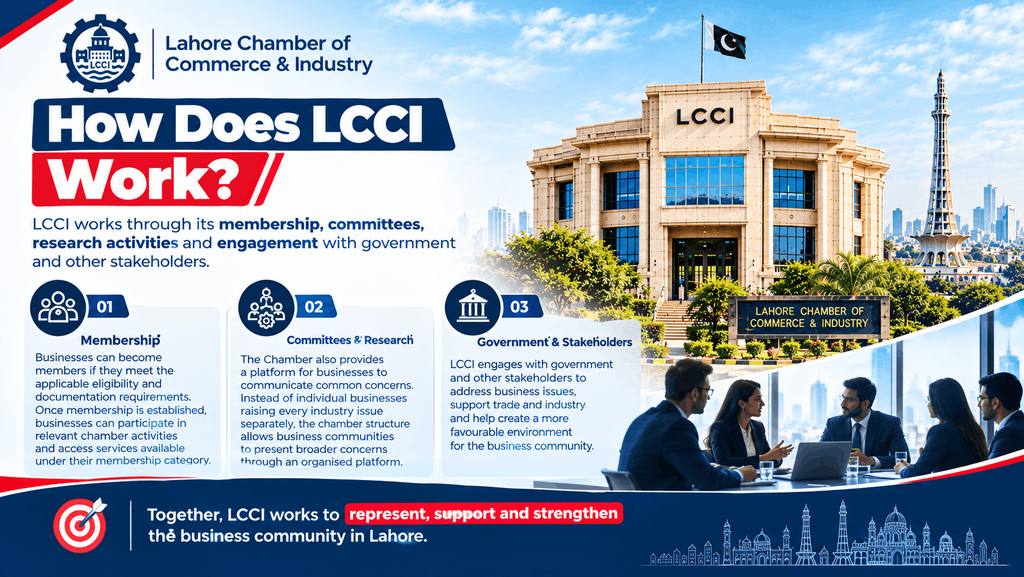
    LCCI works through its membership, committees, research activities and engagement with government and other stakeholders.

    Businesses can become members if they meet the applicable eligibility and documentation requirements. Once membership is established, businesses can participate in relevant chamber activities and access services available under their membership category.

    The Chamber also provides a platform for businesses to communicate common concerns. Instead of individual businesses raising every industry issue separately, the chamber structure allows business communities to present broader concerns through an organized platform.

    5-What Role Does LCCI Play in Pakistan’s Business Community?

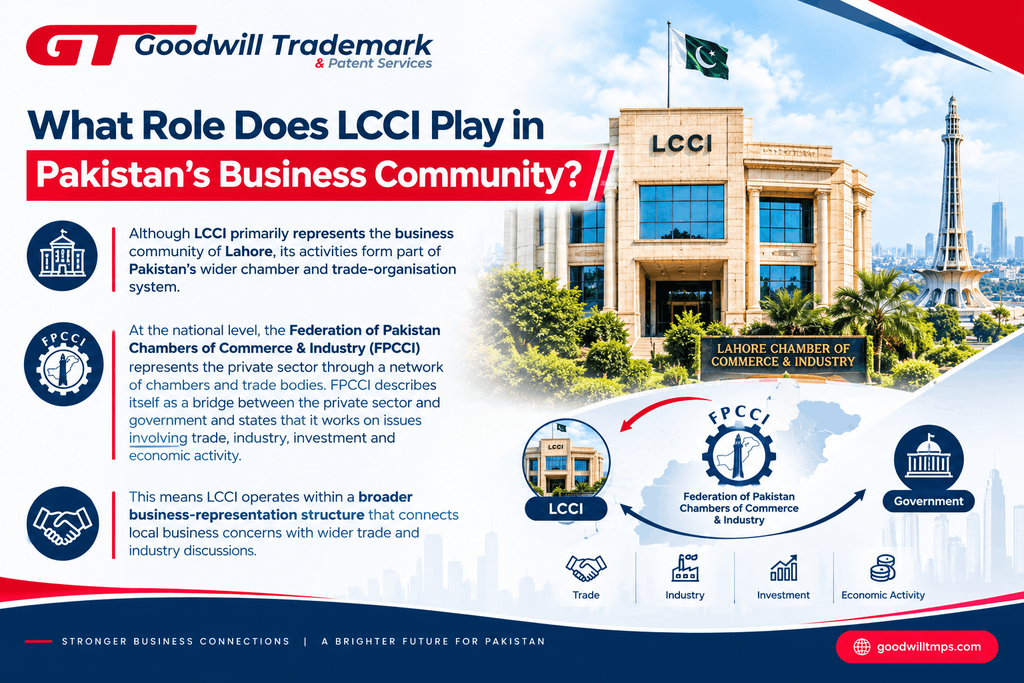
    Although LCCI primarily represents the business community of Lahore, its activities form part of Pakistan’s wider chamber and trade-organization system.

    At the national level, the Federation of Pakistan Chambers of Commerce & Industry (FPCCI) represents the private sector through a network of chambers and trade bodies. FPCCI describes itself as a bridge between the private sector and government and states that it works on issues involving trade, industry, investment and economic activity.

    This means LCCI operates within a broader business-representation structure that connects local business concerns with wider trade and industry discussions.

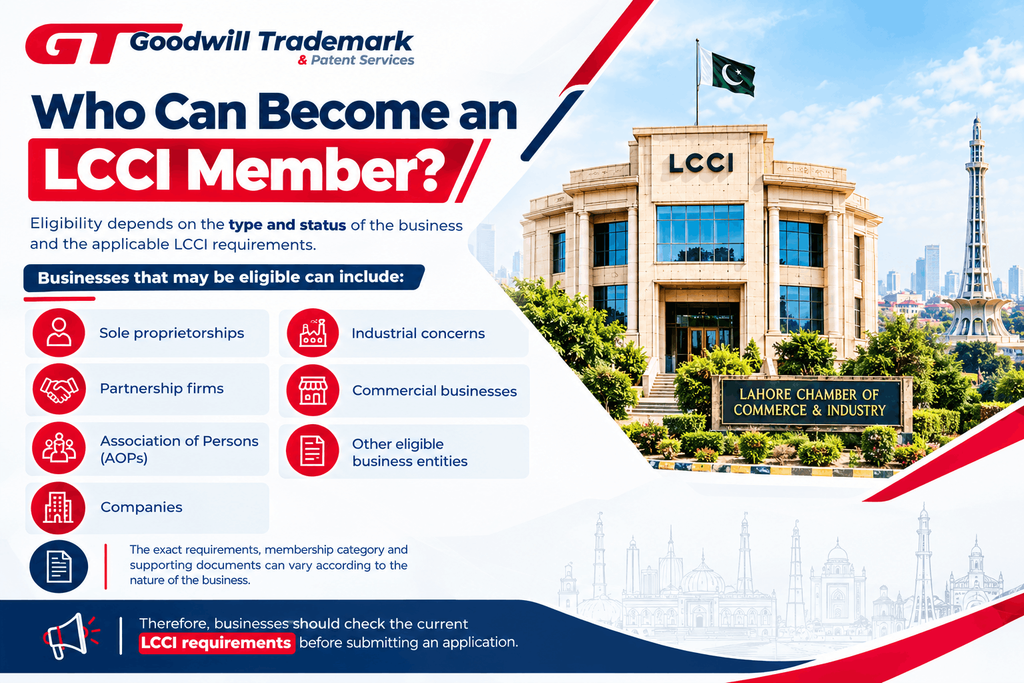
    6-Who Can Become an LCCI Member?

    Eligibility depends on the type and status of the business and the applicable LCCI requirements.

    Businesses that may be eligible can include:

    • Sole proprietorships
    • Partnership firms
    • Association of Persons (AOPs)
    • Companies
    • Industrial concerns
    • Commercial businesses
    • Other eligible business entities

    The exact requirements, membership category and supporting documents can vary according to the nature of the business.

    Therefore, businesses should check the current LCCI requirements before submitting an application.

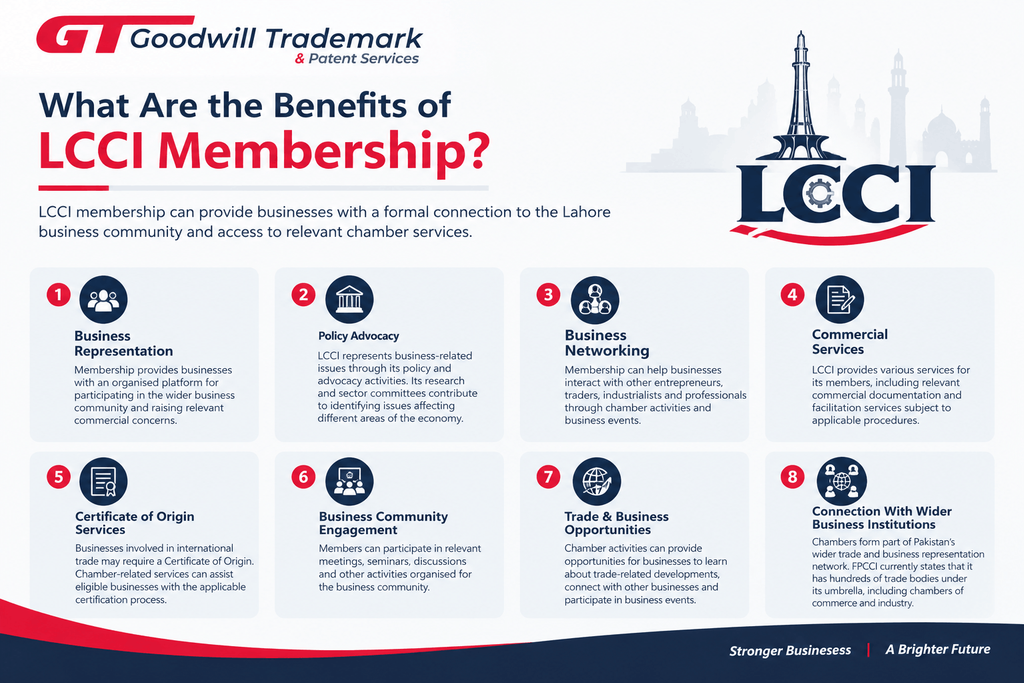
    7-What Are the Benefits of LCCI Membership?

    LCCI membership can provide businesses with a formal connection to the Lahore business community and access to relevant chamber services.

    1. Business Representation

    Membership provides businesses with an organised platform for participating in the wider business community and raising relevant commercial concerns.

    2. Policy Advocacy

    LCCI represents business-related issues through its policy and advocacy activities. Its research and sector committees contribute to identifying issues affecting different areas of the economy.

    3. Business Networking

    Membership can help businesses interact with other entrepreneurs, traders, industrialists and professionals through chamber activities and business events.

    4. Commercial Services

    LCCI provides various services for its members, including relevant commercial documentation and facilitation services subject to applicable procedures.

    5. Certificate of Origin Services

    Businesses involved in international trade may require a Certificate of Origin. Chamber-related services can assist eligible businesses with the applicable certification process.

    6. Business Community Engagement

    Members can participate in relevant meetings, seminars, discussions and other activities organized for the business community.

    7. Trade & Business Opportunities

    Chamber activities can provide opportunities for businesses to learn about trade-related developments, connect with other businesses and participate in business events.

    8. Connection With Wider Business Institutions

    Chambers form part of Pakistan’s wider trade and business representation network. FPCCI currently states that it has hundreds of trade bodies under its umbrella, including chambers of commerce and industry.

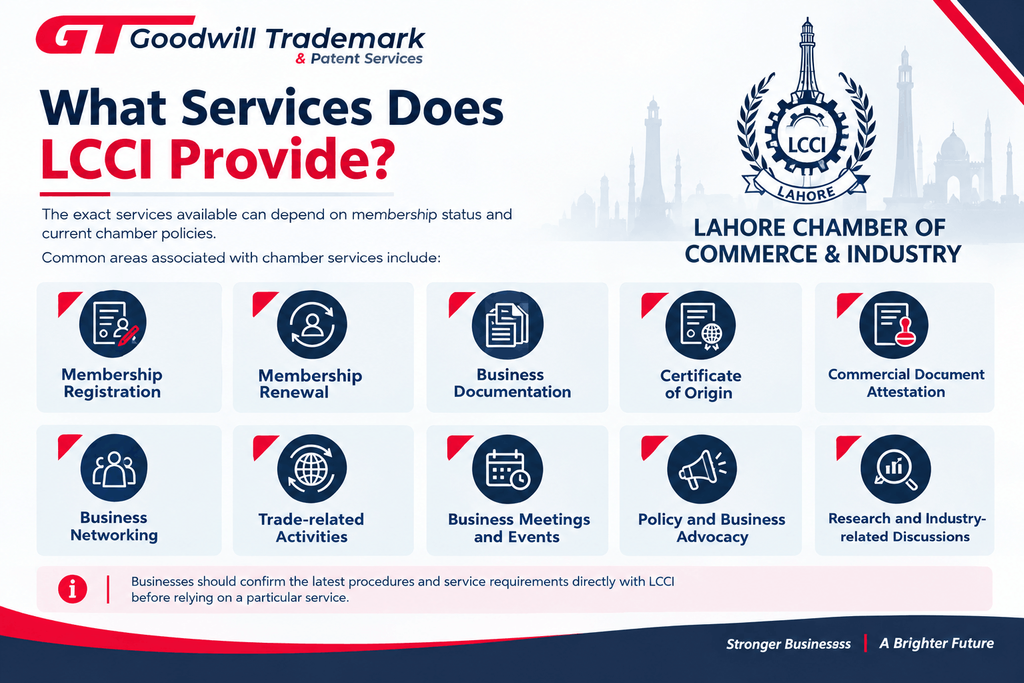
    8-What Services Does LCCI Provide?

    The exact services available can depend on membership status and current chamber policies.

    Common areas associated with chamber services include:

    • Membership registration
    • Membership renewal
    • Business documentation
    • Certificate of Origin
    • Commercial document attestation
    • Business networking
    • Trade-related activities
    • Business meetings and events
    • Policy and business advocacy
    • Research and industry-related discussions

    Businesses should confirm the latest procedures and service requirements directly with LCCI before relying on a particular service.

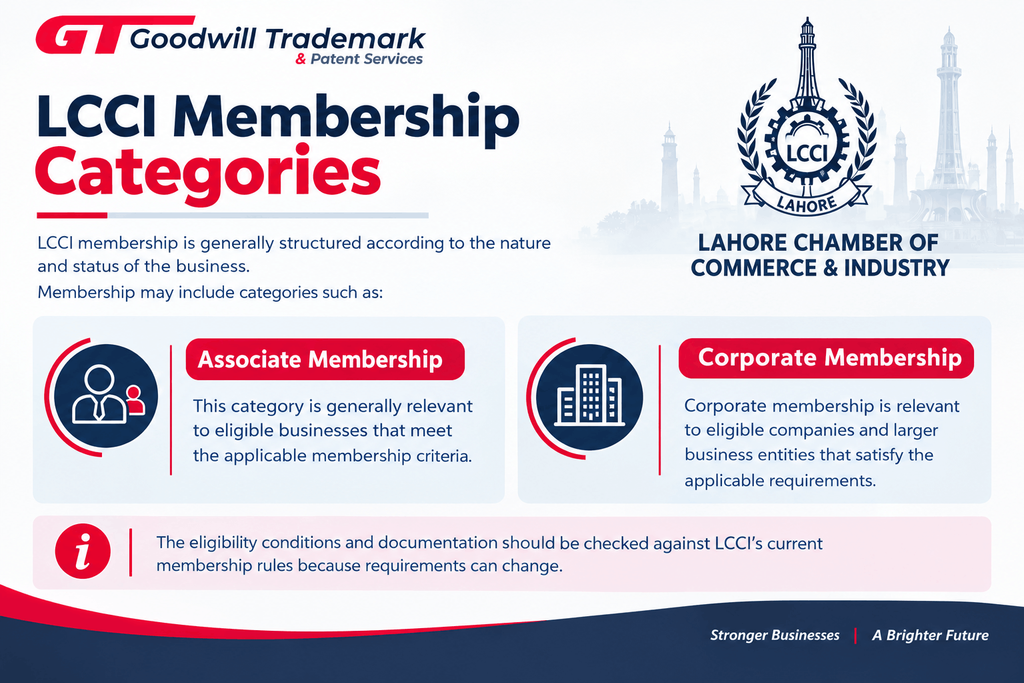
    9-LCCI Membership Categories

    LCCI membership is generally structured according to the nature and status of the business.

    Membership may include categories such as:

    Associate Membership

    This category is generally relevant to eligible businesses that meet the applicable membership criteria.

    Corporate Membership

    Corporate membership is relevant to eligible companies and larger business entities that satisfy the applicable requirements.

    The eligibility conditions and documentation should be checked against LCCI’s current membership rules because requirements can change.

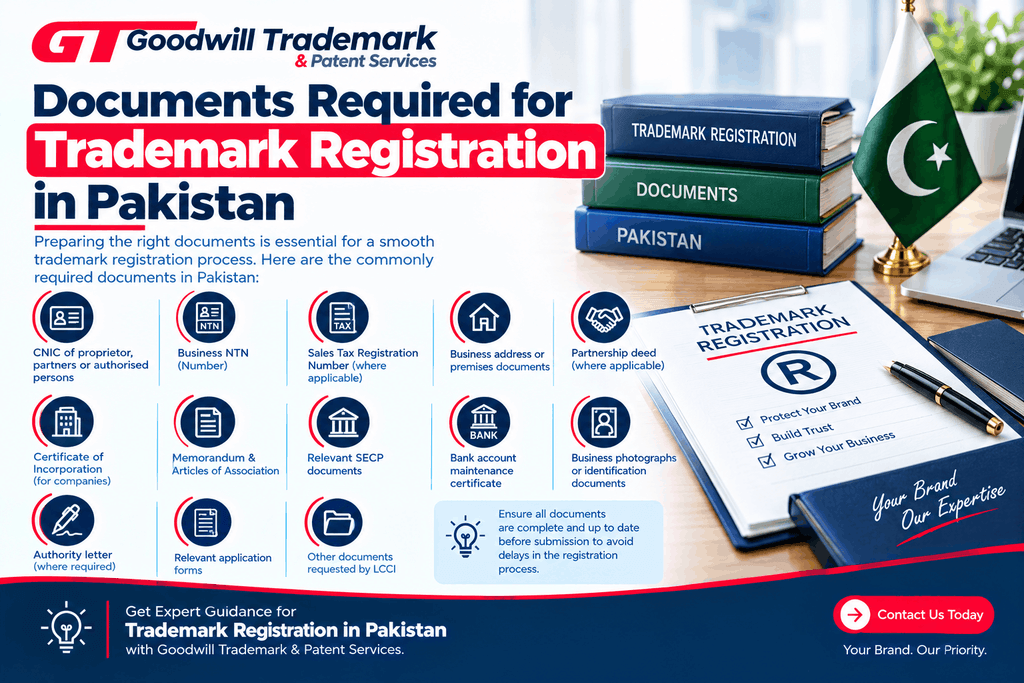
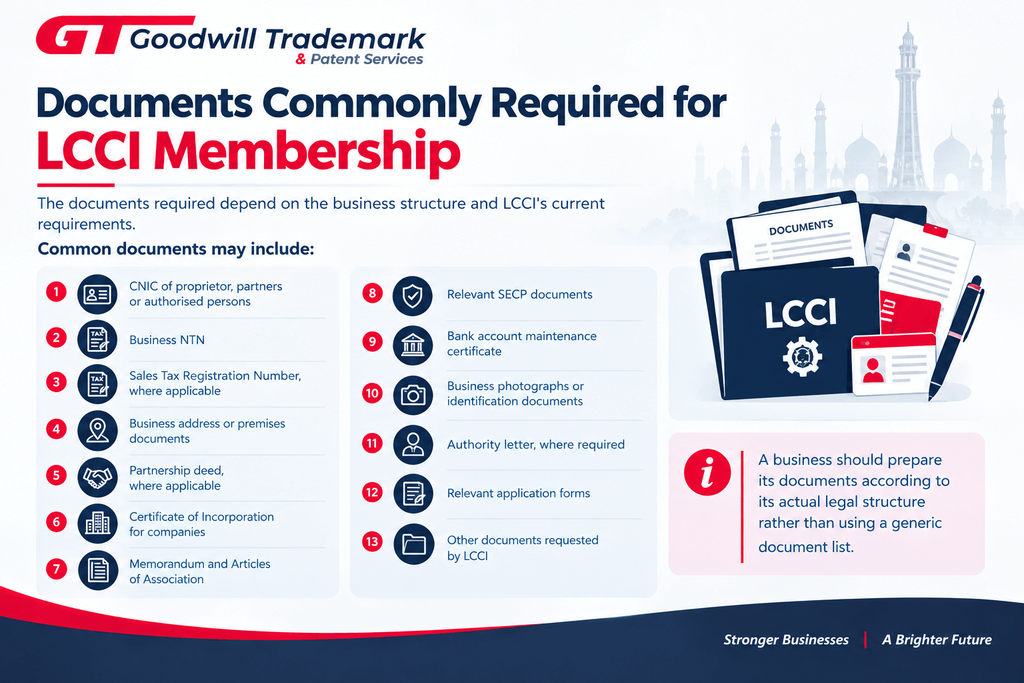
    10-Documents Commonly Required for LCCI Membership

    The documents required depend on the business structure and LCCI’s current requirements.

    Common documents may include:

    • CNIC of proprietor, partners or authorised persons
    • Business NTN
    • Sales Tax Registration Number, where applicable
    • Business address or premises documents
    • Partnership deed, where applicable
    • Certificate of Incorporation for companies
    • Memorandum and Articles of Association
    • Relevant SECP documents
    • Bank account maintenance certificate
    • Business photographs or identification documents
    • Authority letter, where required
    • Relevant application forms
    • Other documents requested by LCCI

    A business should prepare its documents according to its actual legal structure rather than using a generic document list.


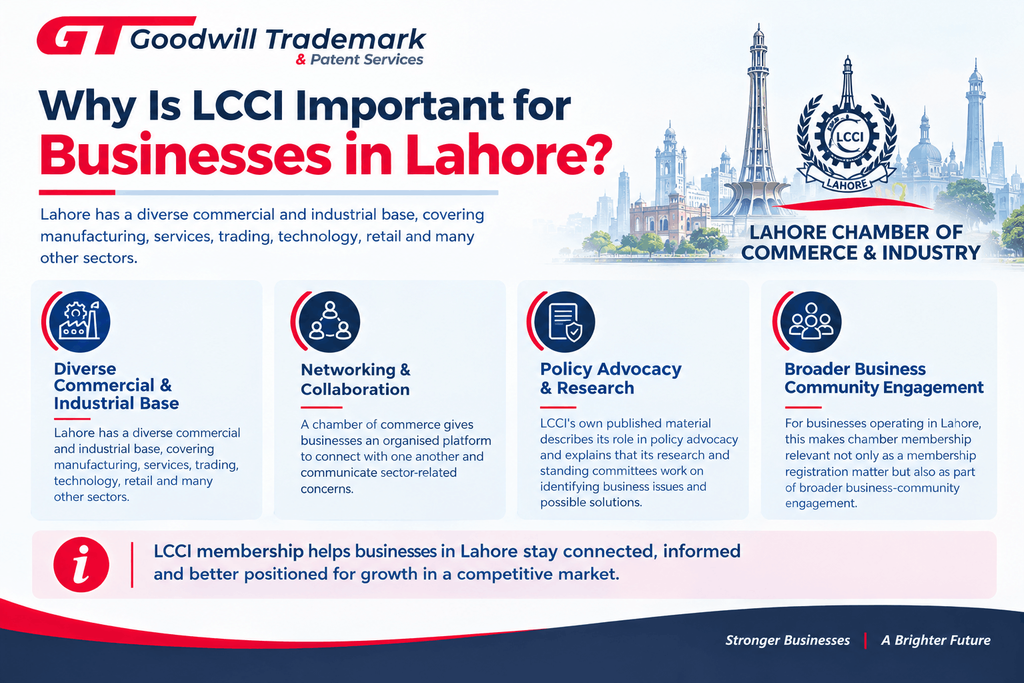
    11-Why Is LCCI Important for Businesses in Lahore?

    Lahore has a diverse commercial and industrial base, covering manufacturing, services, trading, technology, retail and many other sectors.

    A chamber of commerce gives businesses an organized platform to connect with one another and communicate sector-related concerns.

    LCCI’s own published material describes its role in policy advocacy and explains that its research and standing committees work on identifying business issues and possible solutions.

    For businesses operating in Lahore, this makes chamber membership relevant not only as a membership registration matter but also as part of broader business-community engagement.

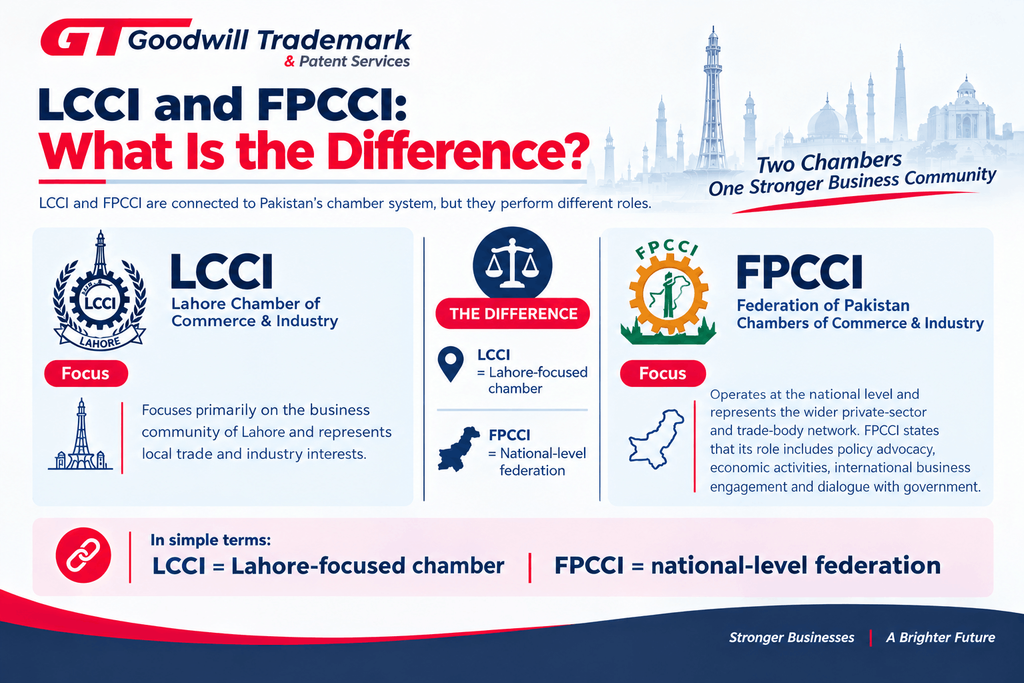
    12-LCCI and FPCCI: What Is the Difference?

    LCCI and FPCCI are connected to Pakistan’s chamber system, but they perform different roles.

    LCCI focuses primarily on the business community of Lahore and represents local trade and industry interests.

    FPCCI, the Federation of Pakistan Chambers of Commerce & Industry, operates at the national level and represents the wider private-sector and trade-body network. FPCCI states that its role includes policy advocacy, economic activities, international business engagement and dialogue with government.

    In simple terms:

    LCCI = Lahore-focused chamber

    FPCCI = national-level federation

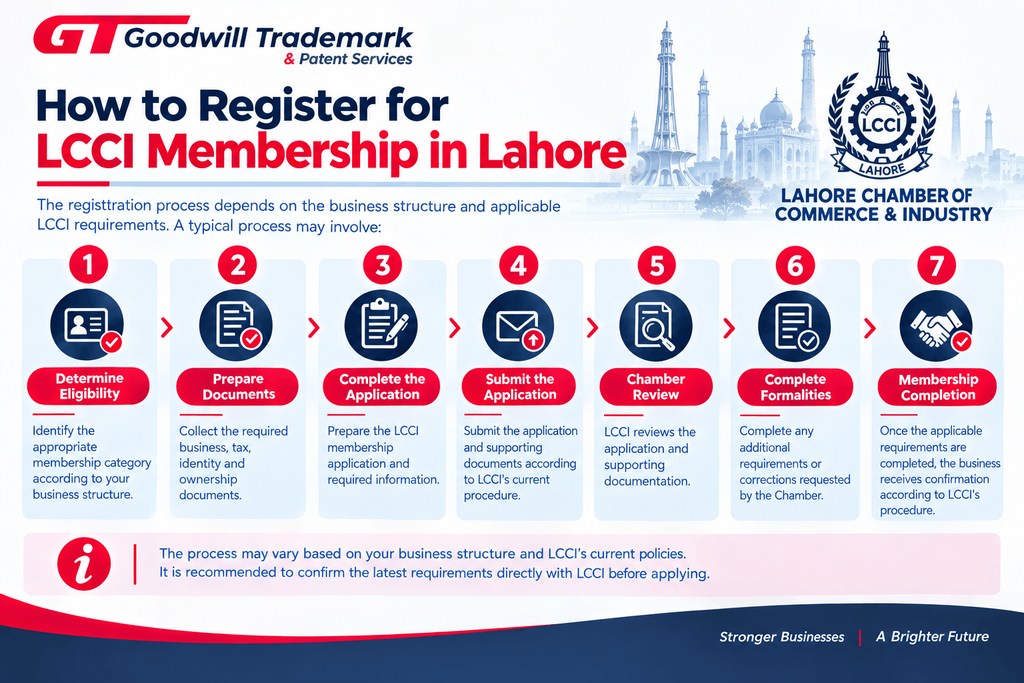
    13-How to Register for LCCI Membership in Lahore

    The registration process depends on the business structure and applicable LCCI requirements. A typical process may involve:

    Step 1: Determine Eligibility | Identify the appropriate membership category according to your business structure.

    Step 2: Prepare Documents | Collect the required business, tax, identity and ownership documents.

    Step 3: Complete the Application | Prepare the LCCI membership application and required information.

    Step 4: Submit the Application | Submit the application and supporting documents according to LCCI’s current procedure.

    Step 5: Chamber Review | LCCI reviews the application and supporting documentation.

    Step 6: Complete Formalities | Complete any additional requirements or corrections requested by the Chamber.

    Step 7: Membership Completion | Once the applicable requirements are completed, the business receives confirmation according to LCCI’s procedure.

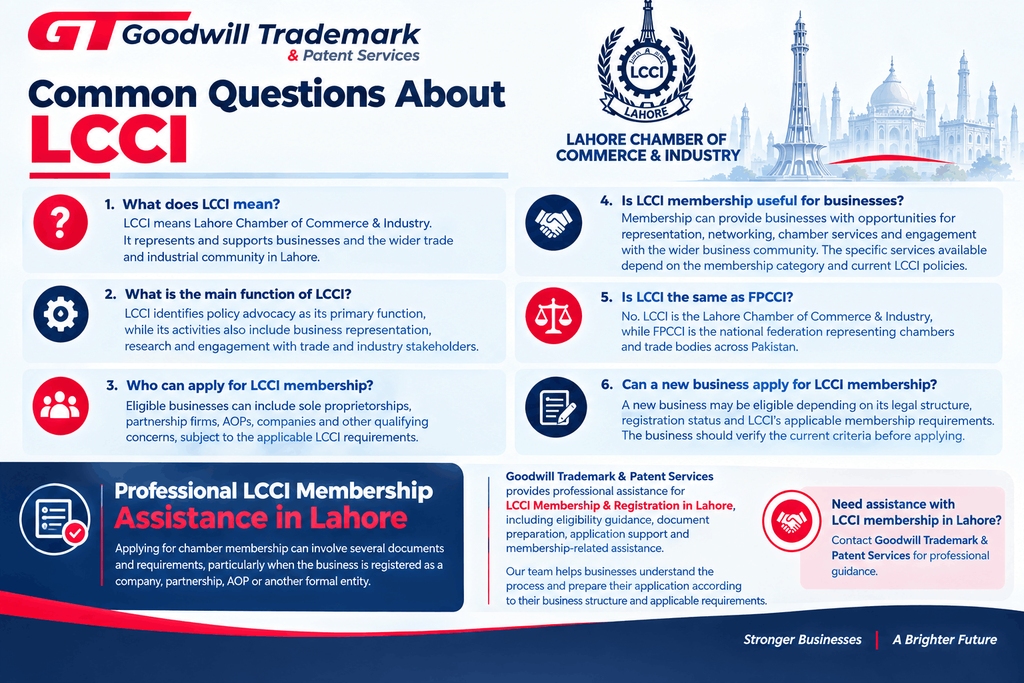
    14-Common Questions About LCCI

    What does LCCI mean?

    LCCI means Lahore Chamber of Commerce & Industry. It represents and supports businesses and the wider trade and industrial community in Lahore.
    What is the main function of LCCI?

    LCCI identifies policy advocacy as its primary function, while its activities also include business representation, research and engagement with trade and industry stakeholders.

    Who can apply for LCCI membership?

    Eligible businesses can include sole proprietorships, partnership firms, AOPs, companies and other qualifying concerns, subject to the applicable LCCI requirements.

    Is LCCI membership useful for businesses?

    Membership can provide businesses with opportunities for representation, networking, chamber services and engagement with the wider business community. The specific services available depend on the membership category and current LCCI policies.

    Is LCCI the same as FPCCI?

    No. LCCI is the Lahore Chamber of Commerce & Industry, while FPCCI is the national federation representing chambers and trade bodies across Pakistan.

    Can a new business apply for LCCI membership?

    A new business may be eligible depending on its legal structure, registration status and LCCI’s applicable membership requirements. The business should verify the current criteria before applying.


    Professional LCCI Membership Assistance in Lahore

    Applying for chamber membership can involve several documents and requirements, particularly when the business is registered as a company, partnership, AOP or another formal entity.

    Goodwill Trademark & Patent Services provides professional assistance for LCCI Membership & Registration in Lahore, including eligibility guidance, document preparation, application support and membership-related assistance.

    Our team helps businesses understand the process and prepare their application according to their business structure and applicable requirements.

    Need assistance with LCCI membership in Lahore? Contact Goodwill Trademark & Patent Services for professional guidance.


    15-Conclusion

    LCCI, or the Lahore Chamber of Commerce & Industry, is an important business organization serving Lahore’s commercial and industrial community. Its role extends beyond membership registration, with activities involving business representation, policy advocacy, research, networking and commercial services.

    For businesses in Lahore, understanding the purpose and requirements of LCCI membership can make the registration process more organized and straightforward.

    If you are planning to apply for LCCI membership, prepare your business and tax documents carefully and verify the latest requirements before submission.

    Goodwill Trademark & Patent Services can assist you with LCCI Membership & Registration in Lahore and help you navigate the documentation and application process.

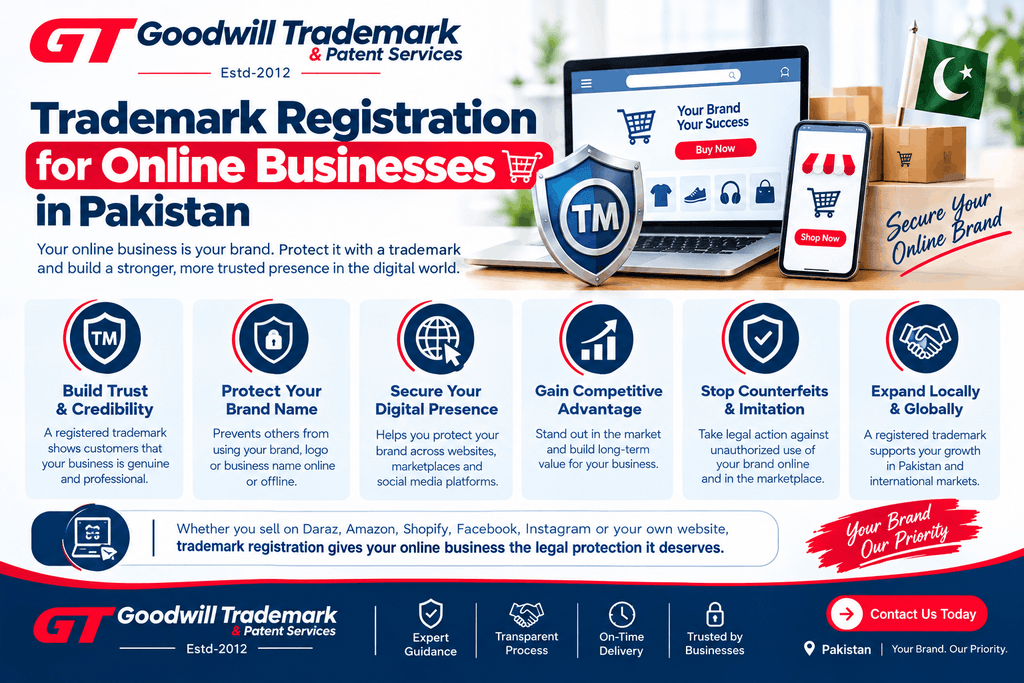
  • Trademark Registration Guide for Pakistani Businesses

    Introduction

    A brand is one of the most valuable assets a business can build. Whether you operate a startup, retail shop, manufacturing company, online store or service-based business, your brand name and logo help customers recognize your products and services.

    However, using a brand in the marketplace does not automatically mean that you have registered it as a trademark.

    Trademark registration in Pakistan provides a legal process for seeking protection for a distinctive brand name, logo or other eligible mark. Registration can help businesses establish their trademark rights, protect their identity and take appropriate action against conflicting marks or unauthorised use, subject to applicable law.

    In Pakistan, trademark registration is administered through the Intellectual Property Organization of Pakistan (IPO-Pakistan) under the Trade Marks Ordinance, 2001, and the applicable Trade Marks Rules, 2004.

    This guide explains how trademark registration works, what documents businesses may need, how to select the correct trademark class and what to consider before submitting an application.

    What Is Trademark Registration?

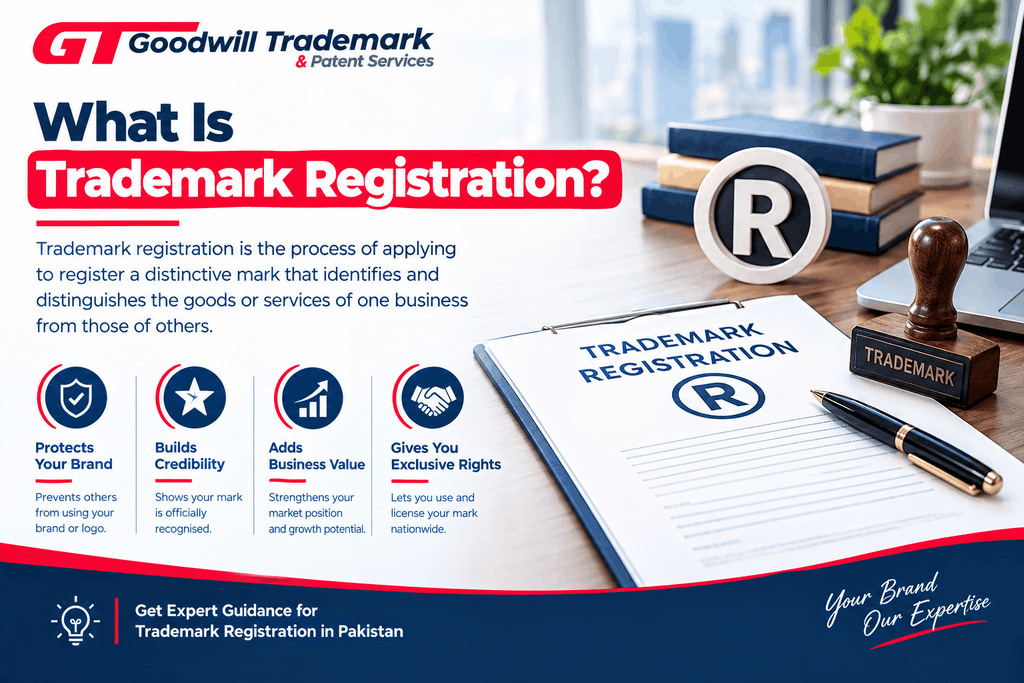
    Trademark registration is the process of applying to register a distinctive mark that identifies and distinguishes the goods or services of one business from those of others.

    A trademark can include a brand name, logo, word, symbol or another sign that qualifies for protection under the applicable law.

    For example, a business may seek trademark protection for:

    • Its company or product brand name
    • Its business logo or symbol
    • The name of a product range
    • A distinctive service brand
    • A qualifying slogan or other brand element

    The availability of protection depends on the mark itself, its use, the relevant goods or services and the legal requirements.

    Trademark registration is different from company registration, business-name registration, domain-name registration and copyright registration. Completing one of these processes does not automatically provide trademark registration.

    Why Is Trademark Registration Important for Pakistani Businesses?

    Businesses invest time and money in developing their names, logos, packaging, advertising and customer relationships. Protecting the identity associated with that investment is an important part of brand management.

    1. Protect Your Brand Identity

    Trademark registration can help establish legal rights in your registered mark for the goods or services covered by the registration.

    2. Reduce the Risk of Brand Conflicts

    A trademark search before filing can help identify potentially conflicting marks and reduce the risk of avoidable disputes.

    3. Build Customer Recognition

    A consistent and protected brand can help customers distinguish your business from competitors.

    4. Support Business Growth

    Businesses planning to expand their product lines, distribution networks or market presence should consider trademark protection as part of their growth strategy.

    5. Strengthen Your Legal Position

    A registered trademark can provide an important basis for pursuing remedies against infringement, subject to the facts of the case and applicable law.

    6. Support Brand Licensing and Transfers

    Trademark rights may be licensed or assigned in accordance with applicable legal requirements. This can be relevant when businesses enter commercial partnerships, franchise arrangements

    or other transactions.

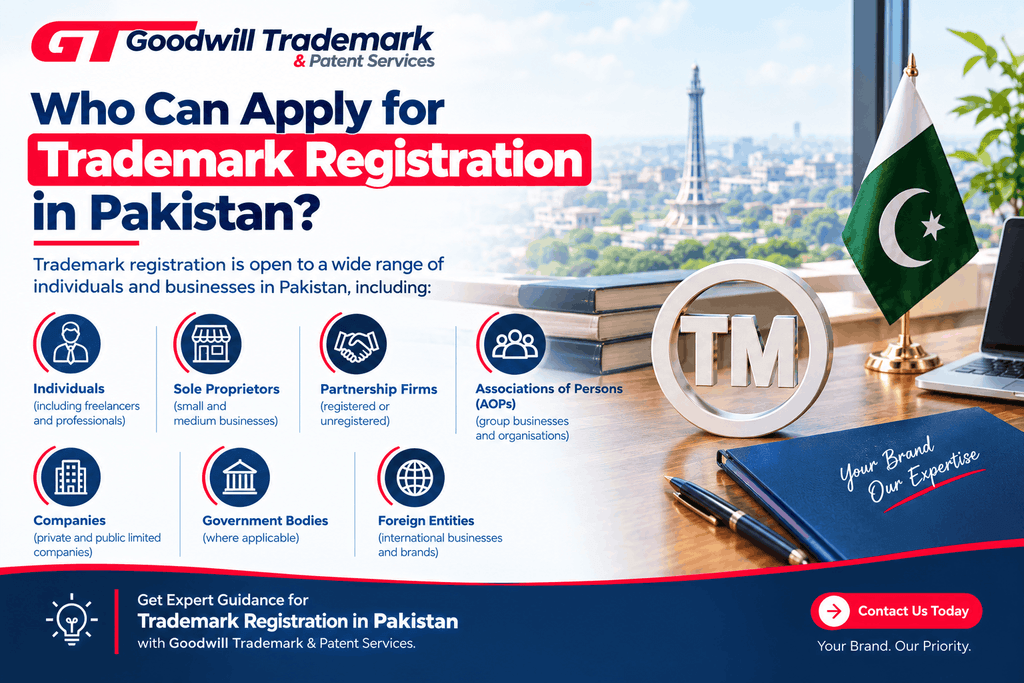
    Who Can Apply for Trademark Registration in Pakistan?

    Depending on the applicable requirements, an application may be filed by an eligible individual or business entity claiming ownership of the mark.

    Applicants may include:

    • Sole proprietors
    • Individual entrepreneurs
    • Partnership firms
    • Association of Persons (AOPs)
    • Private limited companies
    • Public limited companies
    • Manufacturers and product distributors
    • Retail and e-commerce businesses
    • Service providers
    • Startups and established brands

    The applicant should be the correct owner of the trademark. Choosing the owner carefully is important because changing ownership later may require additional documentation and formalities.

    A business should also consider whether the trademark should be owned by an individual, a partnership or a company, particularly where several founders or related businesses are involved.

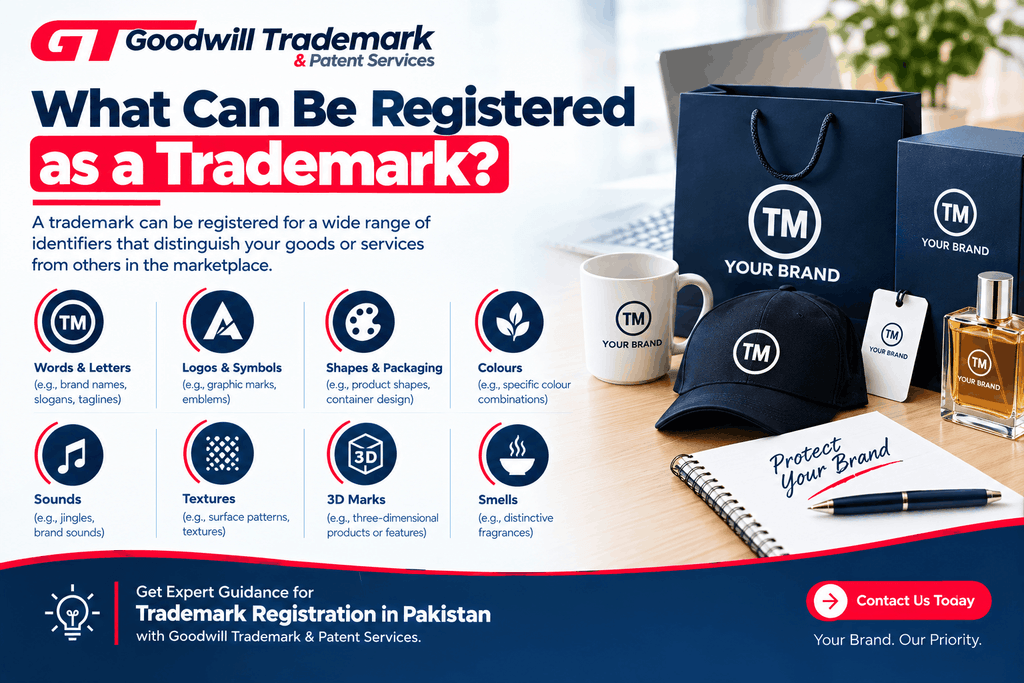
    What Can Be Registered as a Trademark?

    The mark must satisfy the applicable legal requirements, including distinctiveness and any relevant restrictions.

    Brand Names and Word Marks

    A word mark protects the qualifying word or name itself, subject to the scope of registration and applicable law.

    Logos and Brand Symbols

    A logo application seeks protection for the particular visual mark represented in the application.

    Product and Service Brands

    Businesses can seek protection for marks associated with eligible goods or services in the relevant trademark classes.

    Slogans and Other Brand Elements

    Certain slogans or other brand elements may qualify if they meet the legal requirements.

    Not every name, phrase or symbol can be registered. Marks that lack distinctiveness, describe the relevant goods or services, conflict with earlier rights or fall within other legal restrictions may face objections or refusal.

    Trademark Search Before Registration

    Before filing an application, a business should check whether an identical or similar trademark already exists for related goods or services.

    A search can help identify potential conflicts involving:

    • Identical brand names
    • Similar spellings
    • Similar pronunciations
    • Similar logos or visual elements
    • Earlier marks in related goods or services
    • Other potentially relevant registered or pending marks

    A search is an important preliminary step, but it does not guarantee registration. The legal assessment may also depend on the nature of the marks, their goods or services, the relevant records and other circumstances.

    Practical tip: Search for your preferred brand name before investing heavily in packaging, advertising, signage or product launches.

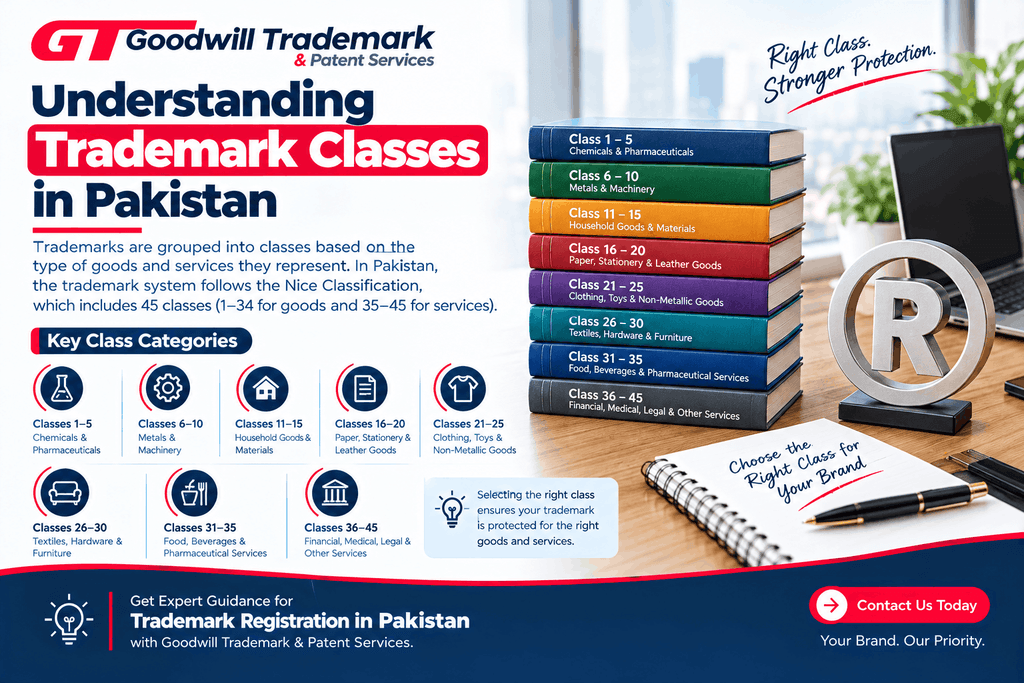
    Understanding Trademark Classes in Pakistan

    Trademark applications identify the goods or services for which protection is sought. These goods and services are organised under the international classification system.

    Selecting the appropriate class is important because trademark protection is connected to the mark and the goods or services covered by the application.

    Examples include:

    • Class 25: Clothing, footwear and headwear
    • Class 30: Many food products, including certain bakery goods, confectionery and spices
    • Class 35: Advertising, business management and certain retail-related services
    • Class 42: Scientific and technological services, software development and related services
    • Class 43: Restaurant, café and catering services

    These are illustrative examples, not a complete classification list. The exact class depends on the specific goods or services.

    A business selling clothing under its own brand may need to consider a different class from a business providing advertising services. Businesses with several product lines or service activities may need protection in more than one class.

    Under Pakistan’s trademark rules, an application is made for goods or services included in a particular class. Separate applications may therefore be necessary when protection is sought in multiple classes.

    Documents Required for Trademark Registration in Pakistan

    The documents and information required can vary depending on the applicant, the type of mark and the circumstances of the application.

    Commonly required information may include:

    • Applicant’s full legal name
    • Applicant’s business or residential address
    • CNIC details for an individual applicant, where applicable
    • Company incorporation or registration details, where applicable
    • Relevant business ownership information
    • A clear representation of the trademark
    • Details of the goods or services
    • The appropriate trademark class
    • Information about the mark’s use, where relevant
    • Power of attorney or agent authorisation, where applicable
    • Supporting evidence or declarations if required

    A logo applicant should prepare a clear image of the mark. If a particular colour combination is an important part of the mark, the application should be prepared with the intended scope of protection in mind.

    Applicants should confirm the current forms and requirements with IPO-Pakistan or their authorised representative before filing.

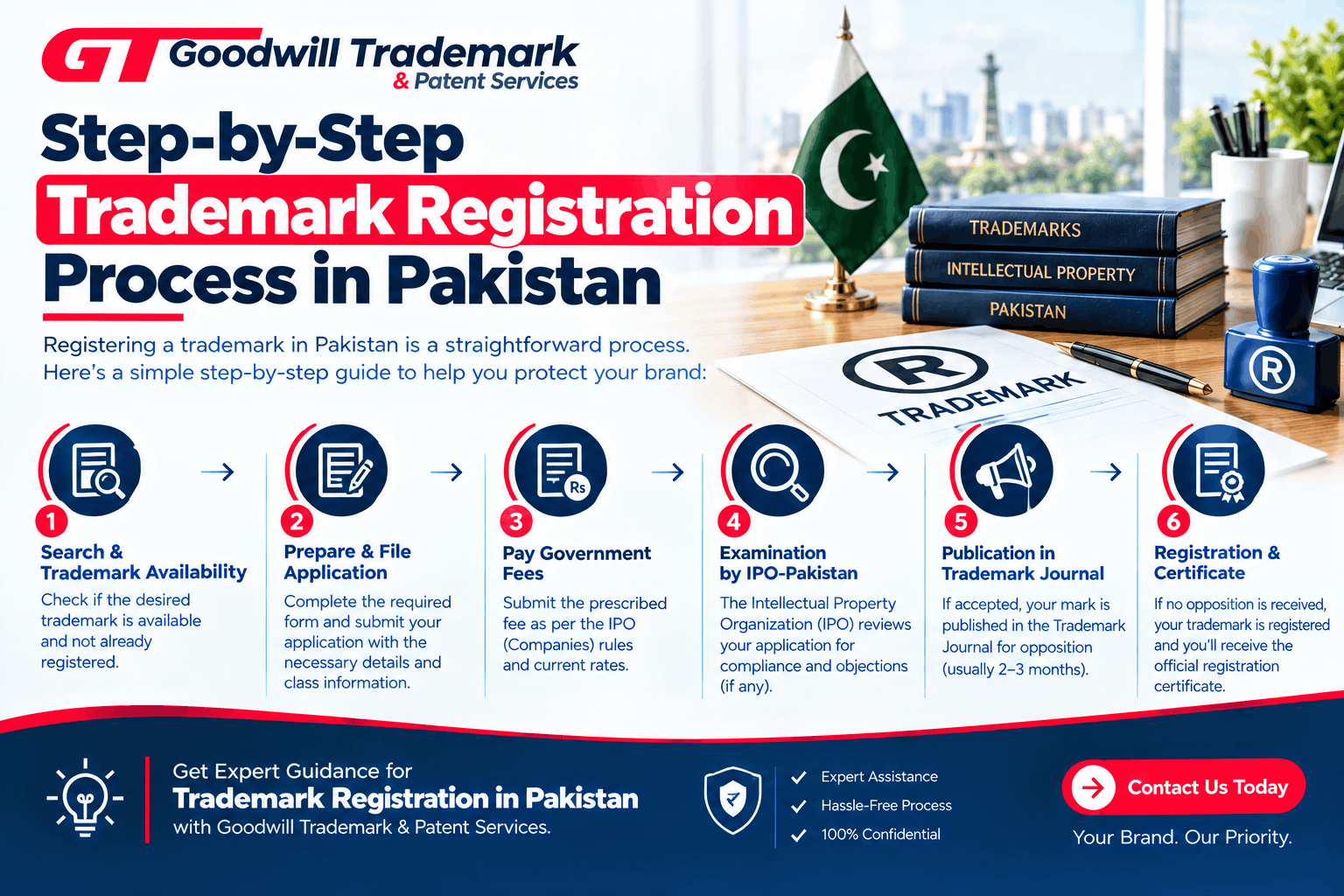
    Step-by-Step Trademark Registration Process in Pakistan

    The following is a general overview of the trademark application process.

    Step 1: Select Your Brand Name or Logo

    Choose the mark you want to protect. A distinctive name is generally a stronger starting point than a term that simply describes the product or service.

    Step 2: Conduct a Trademark Search

    Check for identical or similar marks that may create a conflict. Consider spelling variations, pronunciation and the relevant goods or services.

    Step 3: Identify the Correct Trademark Class

    Determine the class that corresponds to your goods or services. If your business operates across several categories, assess whether additional applications may be necessary.

    Step 4: Prepare the Application

    Prepare the applicant’s details, representation of the mark, goods or services specification and other required information.

    Step 5: File the Application

    Submit the application through the applicable IPO-Pakistan procedure and pay the relevant official fee.

    Step 6: Examination by the Trademark Registry

    The Registry examines the application against the applicable legal requirements. If an objection or examination report is issued, the applicant may need to provide a response or make the required submissions within the prescribed period.

    Step 7: Publication and Opposition

    An application that proceeds to publication is advertised in the relevant trademark publication. This gives eligible third parties an opportunity to oppose registration in accordance with the applicable procedure.

    Step 8: Address Any Opposition

    If a third party opposes the application, the applicant may need to file a counter-statement and participate in the relevant proceedings. The outcome depends on the facts, evidence and applicable law.

    Step 9: Complete Registration Formalities

    If the application successfully completes the relevant stages, the applicant must fulfil the applicable registration requirements and fees before registration is completed.

    Step 10: Maintain Your Trademark

    After registration, keep your ownership records accurate, monitor potential conflicts and track renewal deadlines.

    Important: Filing an application does not mean that the trademark has already been registered. Examination, publication, opposition and other formalities can affect the outcome and timing.

    How Much Does Trademark Registration Cost in Pakistan?

    The total cost depends on the official fees applicable to the filing, the number of classes, the work required and whether professional assistance is used.

    Potential cost components include:

    • Preliminary trademark search
    • Application filing fee
    • Registration-stage fee
    • Professional service charges, if applicable
    • Additional fees for responses, opposition proceedings or other matters, if required
    • Renewal fees when the registration reaches its renewal period

    Pakistan’s trademark fee schedule is set out in the applicable Trade Marks Rules and may be amended. Applicants should verify the latest official fee schedule with IPO-Pakistan before filing rather than relying on an old online fee table.
    Professional service charges are separate from official government fees unless a service provider clearly states that a quoted package includes both.

    For an accurate quotation, confirm the mark, applicant details, intended goods or services and number of classes.

    How Long Does Trademark Registration Take?

    Trademark registration does not have one guaranteed completion time for every application.

    The overall duration can depend on:

    • The Registry’s examination process
    • Whether an objection is raised
    • How quickly the applicant responds
    • Publication and opposition proceedings
    • Whether additional documents or clarification are required
    • The workload and procedures of the relevant authority

    An application with no significant complications may progress differently from one involving an objection or opposition.

    For this reason, businesses should avoid treating a particular number of weeks or months as a guaranteed registration timeline. A realistic estimate should account for the stages that apply to the individual application.

    How Long Does a Trademark Registration Last?

    Under Pakistan’s Trade Marks Ordinance, a trademark registration generally lasts for 10 years, subject to the applicable provisions. It can be renewed for further periods of 10 years by completing the prescribed formalities and paying the relevant fee.

    Trademark owners should maintain a record of the registration date and renewal deadline. If a business changes its name, address or ownership, it should also check whether the Registry’s records need to be updated.

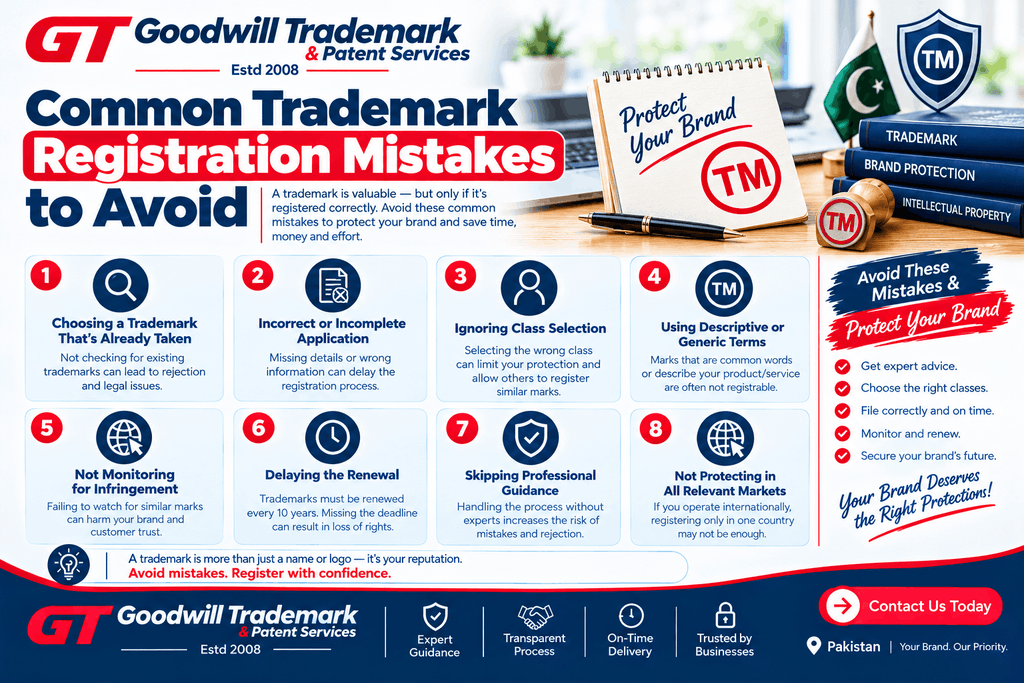
    Common Trademark Registration Mistakes to Avoid

    Choosing a Descriptive Brand Name

    A name that merely describes the goods or services may face distinctiveness issues. Consider whether the proposed mark can distinguish your business from others.

    Skipping the Trademark Search

    Filing without checking for potentially conflicting marks can increase the risk of objections, opposition or disputes.

    Selecting the Wrong Class

    An incorrect or incomplete specification may leave important goods or services outside the intended scope of protection.

    Filing Under the Wrong Owner

    The applicant should reflect the intended legal owner. Mistakes can create complications when transferring or managing the rights later.

    Assuming Application Means Registration

    An application remains subject to the legal process. Do not advertise an application as a completed registration.

    Ignoring Official Correspondence

    Examination reports, objections and opposition notices may carry deadlines. Failing to respond appropriately can affect an application.

    Forgetting Renewal

    A registered trademark needs ongoing management. Missing renewal requirements may put the registration at risk.

    Trademark Registration for Online Businesses in Pakistan

    Online businesses also need to consider brand protection.

    E-commerce sellers, online retailers, software companies and digital service providers may use their brand names on websites, social media, mobile applications, packaging and advertising.

    Before launching a new online brand, businesses should consider:

    • Checking whether the proposed name conflicts with existing marks
    • Identifying the relevant goods or services
    • Applying in the appropriate trademark class or classes
    • Keeping evidence of the mark’s use
    • Monitoring unauthorized use of the brand
    • Considering protection in foreign markets if the business plans to expand internationally

    Registering a domain name or creating a social media account does not, by itself, establish trademark registration.

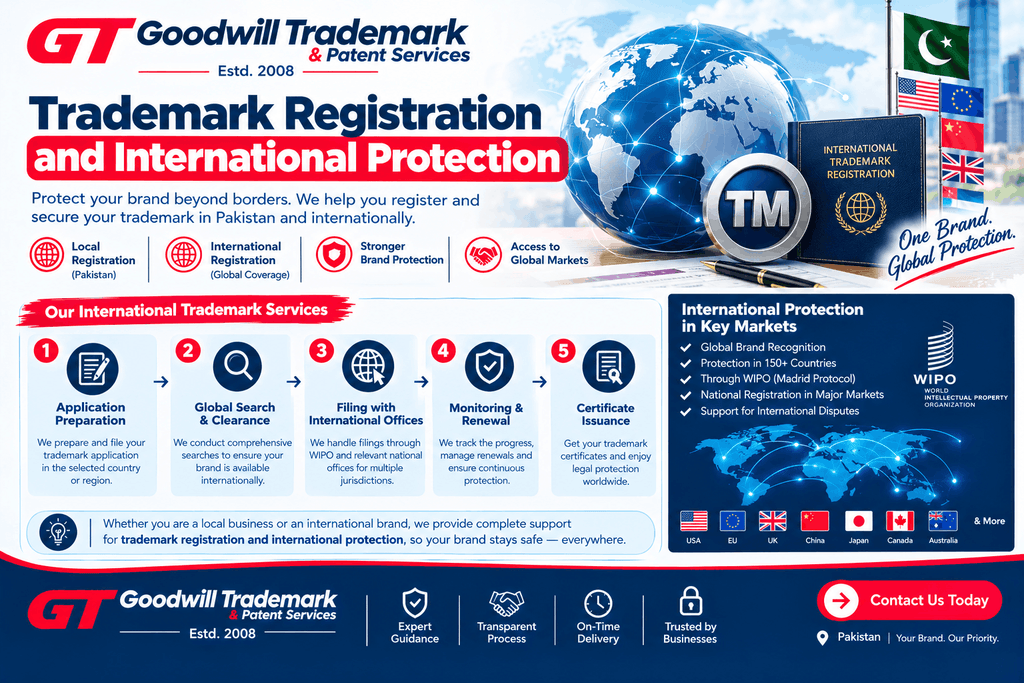
    Trademark Registration and International Protection

    A Pakistani trademark registration does not automatically protect a brand in every country.

    Businesses planning to export products, provide services internationally or sell through foreign marketplaces should assess trademark protection in each relevant market.

    The available filing route, eligibility, fees and requirements depend on the target country and the applicant’s circumstances. International brand protection should therefore be planned according to the business’s expansion strategy.

    Frequently Asked Questions About Trademark Registration in Pakistan

    1. How do I register a trademark in Pakistan?

    Start by selecting a distinctive mark, conducting a search, identifying the correct goods or services and class, preparing the application and filing it through the applicable IPO-Pakistan procedure. The application must then complete the relevant examination and registration stages.

    2. Can I register my business name as a trademark?

    You may apply to register a business name as a trademark if it meets the applicable legal requirements. Business or company-name registration alone does not provide the same protection as trademark registration.

    3. Can I register a logo separately from a brand name?

    Yes, a business can consider separate applications for its word mark and logo. The appropriate filing strategy depends on the brand, the mark’s design and the protection the business seeks.

    4. Do I need a separate application for each trademark class?

    Separate applications are generally required for each class under Pakistan’s applicable trademark filing system. The correct approach should be confirmed against the current rules and filing requirements.

    5. Does trademark registration protect my brand worldwide?

    No. A Pakistani registration does not automatically provide worldwide protection. Businesses must assess protection in the countries where they intend to operate.

    6. Can a trademark application be rejected?

    Yes. An application may face objections or refusal for legal reasons, including issues relating to distinctiveness, prohibited marks or conflicts with earlier rights. The outcome depends on the particular application and applicable law.

    7. Can another business oppose my trademark application?

    An eligible third party may oppose a published application according to the applicable legal procedure. The applicant may need to respond and participate in opposition proceedings.

    8. When should I renew my registered trademark?

    Trademark registrations generally last 10 years and may be renewed for further 10-year periods, subject to the prescribed requirements. Owners should verify their exact renewal dates and current formalities.

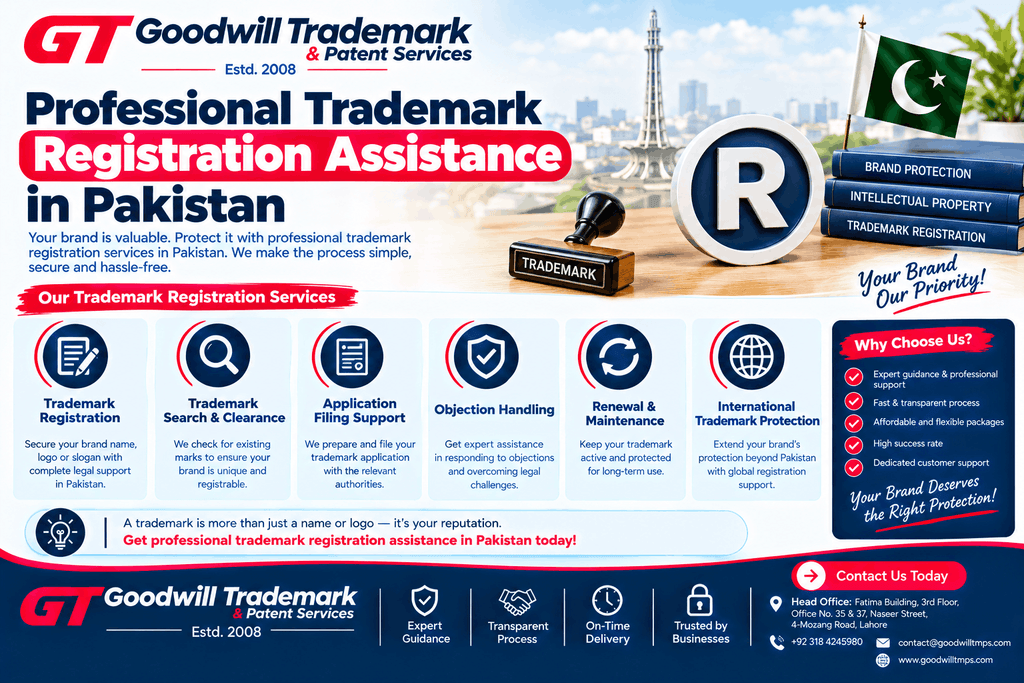
    Professional Trademark Registration Assistance in Pakistan

    Protecting a brand starts with choosing a distinctive mark and following the correct registration procedure.

    Goodwill Trademark & Patent Services assists Pakistani entrepreneurs, startups and established businesses with trademark-related services, including trademark searches, application preparation, class selection, filing support and guidance on examination objections and other registration matters.

    Whether you are launching a new brand or protecting an established business name, our team can help you understand the process and prepare for the relevant requirements.

    Contact Goodwill Trademark & Patent Services for professional trademark registration assistance in Pakistan.
    Conclusion

    Trademark registration is an important consideration for Pakistani businesses that want to protect the identity associated with their products and services.

    A well-prepared application begins with a distinctive mark, a careful search, the correct classification and accurate applicant information. Businesses should also understand that filing is only the start of the process and that examination, publication, opposition and registration formalities may affect the outcome.

    By planning trademark protection early and keeping registration records up to date, businesses can make more informed decisions about their brands.

    For guidance on trademark registration in Pakistan, Goodwill Trademark & Patent Services can help you understand the process and prepare your application according to the applicable requirements.